2,281 posters, 63 videos, 56 audios, 43 topics, 18 sessions, 6,174 authors, 2,323 institutions
ePostersLive by SciGen Technologies S.A. All rights reserved.
RCOG World Congress 2025
June 23 - 25, 2025 | ExCeL London, UK
EP.1317
Ambulatory Fibroid Ablation Service
Poster Presenter
Authors
Affiliations
Part of Topic
Innovation in obstetrics and gynaecology
Ambulatory Fibroid Ablation Service
Objective:
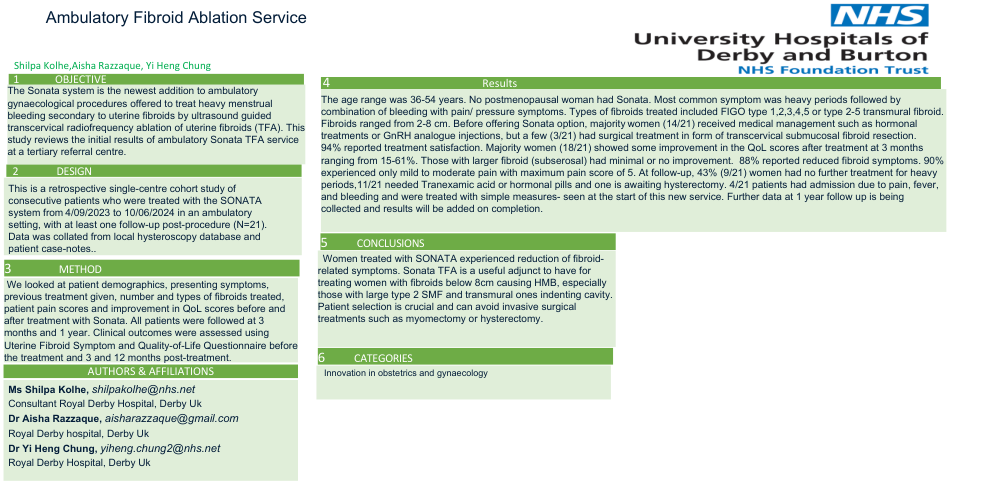
The Sonata system is the newest addition to ambulatory gynaecological procedures offered to treat heavy menstrual bleeding secondary to uterine fibroids by ultrasound guided transcervical radiofrequency ablation of uterine fibroids (TFA). This study reviews the initial results of ambulatory Sonata TFA service at a tertiary referral centre.
Design:
This is a retrospective single-centre cohort study of consecutive patients who were treated with the SONATA system from 4/09/2023 to 10/06/2024 in an ambulatory setting, with at least one follow-up post-procedure (N=21). Data was collated from local hysteroscopy database and patient case-notes.
Method:
We looked at patient demographics, presenting symptoms, previous treatment given, number and types of fibroids treated, patient pain scores and improvement in QoL scores before and after treatment with Sonata. All patients were followed at 3 months and 1 year. Clinical outcomes were assessed using Uterine Fibroid Symptom and Quality-of-Life Questionnaire before the treatment and 3 and 12 months post-treatment.
Results:
The age range was 36-54 years. No postmenopausal woman had Sonata. Most common symptom was heavy periods followed by combination of bleeding with pain/ pressure symptoms. Types of fibroids treated included FIGO type 1,2,3,4,5 or type 2-5 transmural fibroid. Fibroids ranged from 2-8 cm. Before offering Sonata option, majority women (14/21) received medical management such as hormonal treatments or GnRH analogue injections, but a few (3/21) had surgical treatment in form of transcervical submucosal fibroid resection.
94% reported treatment satisfaction. Majority women (18/21) showed some improvement in the QoL scores after treatment at 3 months ranging from 15-61%. Those with larger fibroid (subserosal) had minimal or no improvement. 88% reported reduced fibroid symptoms. 90% experienced only mild to moderate pain with maximum pain score of 5. At follow-up, 43% (9/21) women had no further treatment for heavy periods,11/21 needed Tranexamic acid or hormonal pills and one is awaiting hysterectomy. 4/21 patients had admission due to pain, fever, and bleeding and were treated with simple measures- seen at the start of this new service. Further data at 1 year follow up is being collected and results will be added on completion.
Conclusion:
Women treated with SONATA experienced reduction of fibroid-related symptoms. Sonata TFA is a useful adjunct to have for treating women with fibroids below 8cm causing HMB, especially those with large type 2 SMF and transmural ones indenting cavity. Patient selection is crucial and can avoid invasive surgical treatments such as myomectomy or hysterectomy.