2,281 posters, 63 videos, 56 audios, 43 topics, 18 sessions, 6,174 authors, 2,323 institutions
ePostersLive by SciGen Technologies S.A. All rights reserved.
RCOG World Congress 2025
June 23 - 25, 2025 | ExCeL London, UK
EP.1316
Pelvic Pain Management Programmes: An Innovative Approach to Reducing Admissions and Costs
Poster Presenter
Authors
Katherine Whitcher, Gemma Bentham, Kelly Paull, Nicoleta Boingeanu, Rebecca Noy, Jessica Preshaw
Affiliations
Part of Topic
Innovation in obstetrics and gynaecology
Background
•Persistent pelvic pain (PPP) is the most common gynaecological referral affecting 38% women annually.
•PPP significantly impacts quality of life, & incurs significant financial burden, costing the NHS > $326 million annually.
•Pain management programmes (PMPs) are an evidence-based, multidisciplinary approach to addressing chronic pain.
•In 2021 North Bristol Trust introduced a Pelvic PMP; the first of its kind in the South-West region.
Aims
•To assess the impact of the programme on number of acute pelvic pain related hospital events (hot clinic attendances, ED attendances & 24-hour inpatient stays).
•To quantify the financial impact of this.
Method
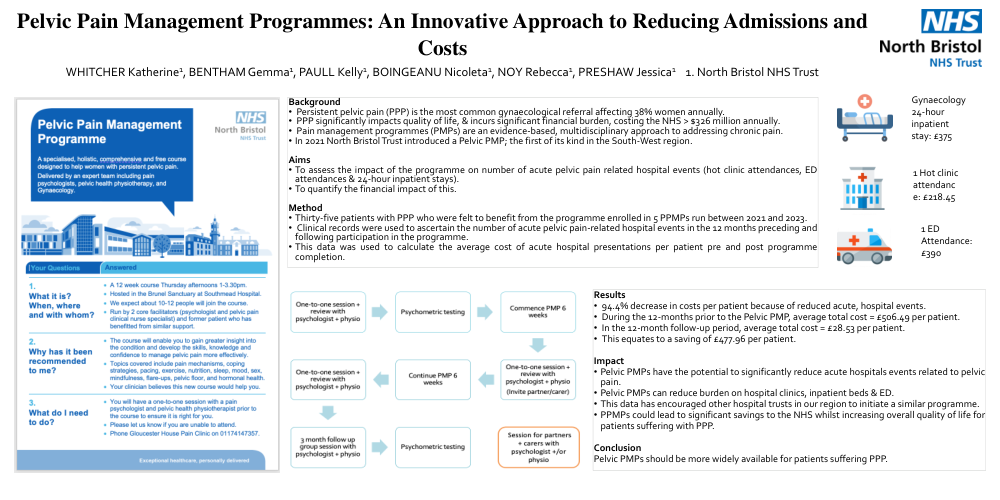
•Thirty-five patients with PPP who were felt to benefit from the programme enrolled in 5 PPMPs run between 2021 and 2023.
• Clinical records were used to ascertain the number of acute pelvic pain-related hospital events in the 12 months preceding and following participation in the programme.
•This data was used to calculate the average cost of acute hospital presentations per patient pre and post programme completion.
Results
•94.4% decrease in costs per patient because of reduced acute, hospital events.
•During the 12-months prior to the Pelvic PMP, average total cost = £506.49 per patient.
•In the 12-month follow-up period, average total cost = £28.53 per patient.
•This equates to a saving of £477.96 per patient.
Impact
•Pelvic PMPs have the potential to significantly reduce acute hospitals events related to pelvic pain.
•Pelvic PMPs can reduce burden on hospital clinics, inpatient beds & ED.
•This data has encouraged other hospital trusts in our region to initiate a similar programme.
•PPMPs could lead to significant savings to the NHS whilst increasing overall quality of life for patients suffering with PPP.
Conclusion
Pelvic PMPs should be more widely available for patients suffering PPP.