2,281 posters, 63 videos, 56 audios, 43 topics, 18 sessions, 6,174 authors, 2,323 institutions
ePostersLive by SciGen Technologies S.A. All rights reserved.
RCOG World Congress 2025
June 23 - 25, 2025 | ExCeL London, UK
EP.1315
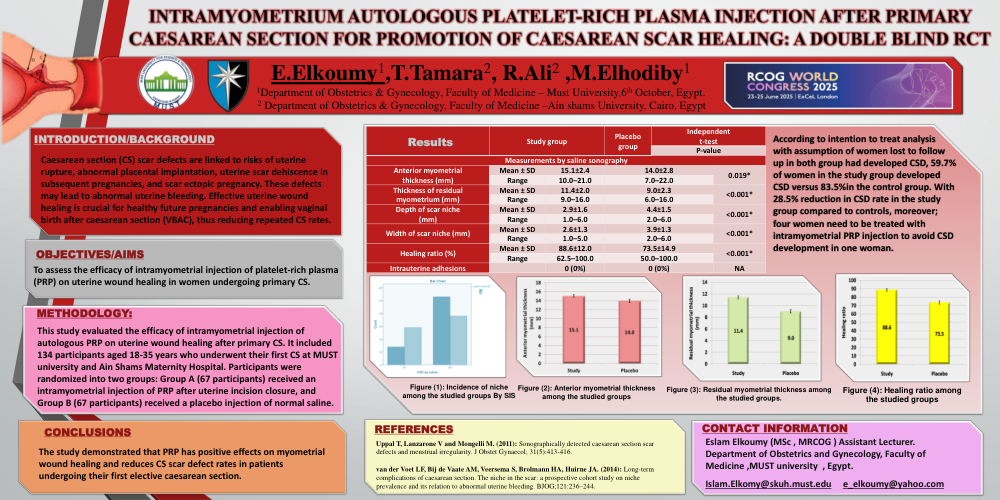
Intramyometrium Autologous PRP Injection after Primary caesarean section for caesarean scar healing
Part of Topic
Innovation in obstetrics and gynaecology
INTRODUCTION/BACKGROUND
Caesarean section (CS) scar defects are linked to risks of uterine rupture, abnormal placental implantation, uterine scar dehiscence in subsequent pregnancies, and scar ectopic pregnancy. These defects may lead to abnormal uterine bleeding. Effective uterine wound healing is crucial for healthy future pregnancies and enabling vaginal birth after caesarean section (VBAC), thus reducing repeated CS rates.
The Aim:
To assess the efficacy of intramyometrial injection of PRP on uterine wound healing in women undergoing primary CS.
Design and Methods:
This was interventional randomized placebo controlled double blinded clinical trial study
The study was conducted at Ain Shams University Maternity Hospital and MUST university hospital during the period between February and September 2020. They were recruited after obtaining an informed consent and Ethical approval was obtained from the ethical committee at AIN Shams and
MUST University Maternity hospital. They were randomized into two groups.
Study group (A): consist of 67 participant undergoing elective primary CS that received intra myometrial injection of autologous platelet rich plasma after closure of uterine incision.
Placebo group (B): consist of 67 participant that received intra myometrial injection of normal saline The following findings were recorded; the thickness of the myometrium bordering the scar, the depth and the width of the defect, Intrauterine adhesions related to the scar, the healing ratio (the thickness of residual myometrium covering the defect divided by the sum of the thickness of residual myometrium cover the defect and the height of wedge shaped defect) and CSD shape three months after CS.
Results:
The incidence of scar niche was 56.7% in the study group and 79.1 % in placebo group.
▪ The healing of scar was better in study group than placebo group. Healing ratio was 88.6±12.0 among study group. on the other hand, it was 73.5±14.9
among placebo group.
▪ Niche depth and width were significantly shorter in cases with niche among study group which were 2.9±1.6 (mm) and 2.6±1.3 (mm), respectively; in comparison to placebo group which were 4.4±1.5 (mm) and 3.9±1.3 (mm), respectively.
▪ Anterior myometrial thickness was significantly higher among study group (15.1 mm) than among placebo group (14.0 mm).
▪ The residual myometrial thickness was significantly higher among study group (11.4 mm) than among placebo group (9.0 mm)
Conclusions:
This study demonstrated that PRP has positive effects on myometrial wound healing and CSD rate reduction in women who underwent their first elective caesarean section
REFERENCES
Uppal T, Lanzarone V and Mongelli M. (2011): Sonographically detected caesarean section scar defects and menstrual irregularity. J Obstet Gynaecol; 31(5):413-416.
van der Voet LF, Bij de Vaate AM, Veersema S, Brolmann HA, Huirne JA. (2014): Long-term complications of caesarean section. The niche in the scar: a prospective cohort study on niche prevalence and its relation to abnormal uterine bleeding. BJOG;121:236–244.