2,281 posters, 63 videos, 56 audios, 43 topics, 18 sessions, 6,174 authors, 2,323 institutions
ePostersLive by SciGen Technologies S.A. All rights reserved.
RCOG World Congress 2025
June 23 - 25, 2025 | ExCeL London, UK
EP.1174
Transcervical Radiofrequency Ablation –a novel treatment option for large Adenomyoma
Poster Presenter
Authors
Affiliations
Part of Topic
Hot topics (emerging research/issues) in gynaecology
Transcervical radiofrequency ablation –a novel treatment option for large adenomyoma.
OBJECTIVE
Adenomyosis is characterized by the ectopic presence of endometrial tissue within the myometrium, often causing menorrhagia, dysmenorrhea, and infertility. Conventional treatment options include medical or surgical options that may jeopardize fertility.
We present the case a 40-year-old lady with a focal adenomyoma, successfully treated with Transcervical Radiofrequency Ablation with Sonata system.
CASE REPORT
40-year-old nullipara presented to the gynaecology clinic with a 4-year history of heavy menstrual bleeding, dysmenorrhea and pelvic pain.
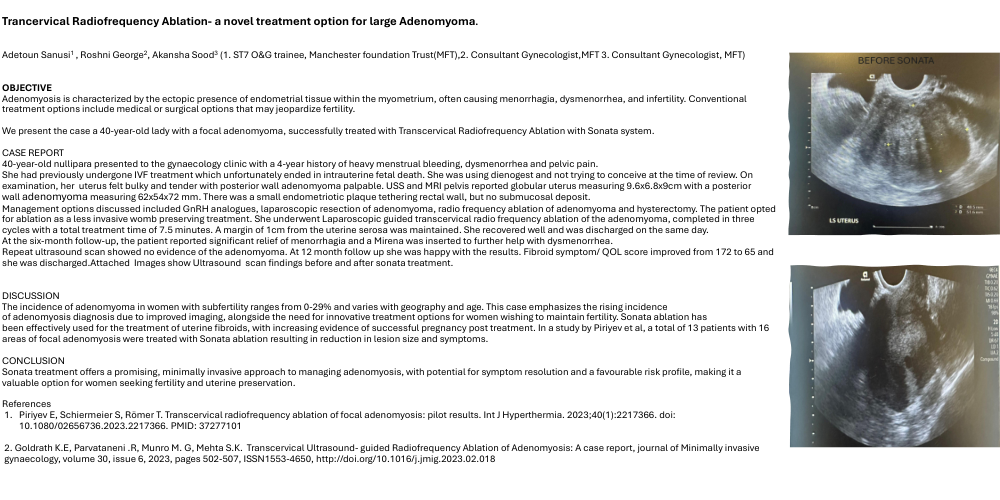
She had previously undergone IVF treatment which unfortunately ended in intrauterine fetal death. She was using dienogest and not keen on conception at the time of review. On examination uterus felt bulky and tender with posterior wall adenomyoma palpable. USS and MRI pelvis reported globular uterus measuring 9.6x6.8x9cm with a posterior wall adenomyoma measuring 62x54x72 mm. There was a small endometriotic plaque tethering rectal wall, but no submucosal deposit.
Management options discussed included GnRH analogues, laparoscopic resection of adenomyoma, radio frequency ablation of adenomyoma and hysterectomy. The patient opted for ablation as a less invasive womb preserving treatment. She underwent Laparoscopic guided transcervical radio frequency ablation of the adenomyoma, which was completed in three cycles with a total treatment time of 7.5 minutes. A margin of 1cm from the uterine serosa was maintained. She recovered well and was discharged on the same day.
At the six-month follow-up, the patient reported significant relief of menorrhagia and a Mirena was inserted to further help with dysmenorrhea.
Repeat ultrasound scan showed no evidence of the adenomyoma. At 12 month follow up she was happy with the results. Fibroid symptom/ QOL score improved from 172 to 65.
DISCUSSION
The incidence of adenomyoma in women with subfertility ranges from 0-29% and varies with geography and age. This case emphasizes the rising incidence of adenomyosis diagnosis due to improved imaging, alongside the need for innovative treatment options for women wishing to maintain fertility. Sonata ablation has been effectively used for the treatment of uterine fibroids, with increasing evidence of successful pregnancy post treatment. In a study by Piriyev et al, a total of 13 patients with 16 areas of focal adenomyosis were treated with Sonata ablation resulting in reduction in lesion size and symptoms.
CONCLUSION
Sonata treatment offers a promising, minimally invasive approach to managing adenomyosis, with potential for symptom resolution and a favourable risk profile, making it a valuable option for women seeking fertility and uterine preservation.
Reference
- Piriyev E, Schiermeier S, Römer T. Transcervical radiofrequency ablation of focal adenomyosis: pilot results. Int J Hyperthermia. 2023;40(1):2217366. doi: 10.1080/02656736.2023.2217366. PMID: 37277101
- Goldrath K.E, Parvataneni .R, Munro M. G, Mehta S.K. Transcervical Ultrasound- guided Radiofrequency Ablation of Adenomyosis: A case report, journal of Minimally invasive gynaecology, volume 30, issue 6, 2023, pages 502-507, ISSN1553-4650, http://doi.org/10.1016/j.jmig.2023.02.018