2,281 posters, 63 videos, 56 audios, 43 topics, 18 sessions, 6,174 authors, 2,323 institutions
ePostersLive by SciGen Technologies S.A. All rights reserved.
RCOG World Congress 2025
June 23 - 25, 2025 | ExCeL London, UK
EP.1170
Depression and quality of life in women following elective hysterectomy
Part of Topic
Hot topics (emerging research/issues) in gynaecology
IntroductionHysterectomy is a common gynaecological surgical procedure worldwide. It affects women’s physical health, psychological health and quality of life.The relationship between hysterectomy and depression has been raised for several decades. Previous studies have reached contradictory evidence concerning the risk of depression and affect on the quality of life following hysterectomy.The data regarding hysterectomy and its psychosocial outcome is scarce in the Sri Lankan context. This study aims to fill this knowledge gap.Objectives of the studyGeneral objective
•To study the rate of depression and quality of life and its correlates in women following elective hysterectomy in a tertiary-care hospital in Sri Lanka.Specific objectives
•To estimate the rate of depressionin women following hysterectomy
•To determine the quality of lifein women following hysterectomy
•To determine the associationbetween depression and quality of life in women following hysterectomy
•To identify significant clinical and/or demographic associations with depression and quality of life in women following hysterectomyMethodology
Study design: Longitudinal observational study
Study setting: Gynecology out-patient and in-patient settings at Colombo North Teaching Hospital (CNTH), Ragama, Sri Lanka
Sample size: 81
Inclusion criteria: Consented patients of 18-65 years of age awaiting hysterectomy for a benign indication
Exclusion criteria: Malignant gynaecological condition, iatrogenic injuries to genitourinary and/or gastrointestinal tracts during the procedure, on antidepressants
Study period: August 2020 to April 2021
Study instruments:
Beck Depression Inventory-II (BDI-II)
World Health Organization Quality of Life-BREF (WHOQoL-BREF)
Interviewer-administered data extraction sheet
Data collection: At three-time points; 2 weeks before the surgery, 3 and 6 months after the surgery
Ethics approval: Ethics Review Committee of the Faculty of Medicine, University of Kelaniya
Results
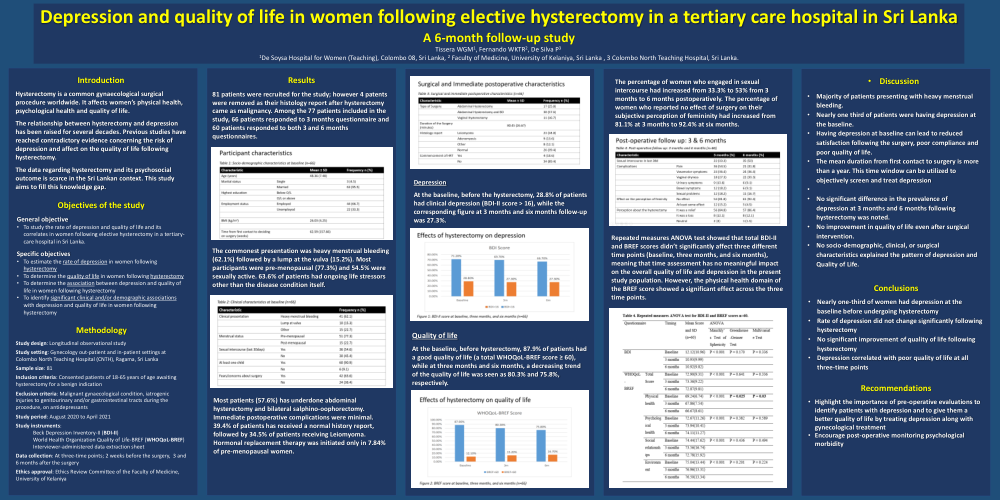
81 patients were recruited for the study; however 4 patents were removed as their histology report after hysterectomy came as malignancy. Among the 77 patients included in the study, 66 patients responded to 3 months questionnaire and 60 patients responded to both 3 and 6 months questionnaires.
The commonest presentation was heavy menstrual bleeding (62.1%) followed by a lump at the vulva (15.2%). Most participants were pre-menopausal (77.3%) and 54.5% were sexually active. 63.6% of patients had ongoing life stressors other than the disease condition itself.
Most patients (57.6%) has underdone abdominal hysterectomy and bilateral salphino-oophorectomy. Immediate postoperative complications were minimal. 39.4% of patients has received a normal history report, followed by 34.5% of patients receiving Leiomyoma. Hormonal replacement therapy was initiated only in 7.84% of pre-menopausal women.
Depression
At the baseline, before the hysterectomy, 28.8% of patients had clinical depression (BDI-II score >16), while the corresponding figure at 3 months and six months follow-up was 27.3%.
Quality of life
At the baseline, before hysterectomy, 87.9% of patients had a good quality of life (a total WHOQoL-BREF score ≥ 60), while at three months and six months, a decreasing trend of the quality of life was seen as 80.3% and 75.8%, respectively.
The percentage of women who engaged in sexual intercourse had increased from 33.3% to 53% from 3 months to 6 months postoperatively. The percentage of women who reported no effect of surgery on their subjective perception of femininity had increased from 81.1% at 3 months to 92.4% at six months.
Repeated measures ANOVA test showed that total BDI-II and BREF scores didn’t significantly affect three different time points (baseline, three months, and six months), meaning that time assessment has no meaningful impact on the overall quality of life and depression in the present study population. However, the physical health domain of the BREF score showed a significant effect across the three time points.
Discussion
Majority of patients presenting with heavy menstrual bleeding.•Nearly one third of patients were having depression at the baseline.•Having depression at baseline can lead to reduced satisfaction following the surgery, poor compliance and poor quality of life. •The mean duration from first contact to surgery is more than a year. This time window can be utilized to objectively screen and treat depression••No significant difference in the prevalence of depression at 3 months and 6 months following hysterectomy was noted. •No improvement in quality of life even after surgical intervention. •No socio-demographic, clinical, or surgical characteristics explained the pattern of depression and Quality of Life.
Conclusions•Nearly one-third of women had depression at the baseline before undergoing hysterectomy•Rate of depression did not change significantly following hysterectomy•No significant improvement of quality of life following hysterectomy•Depression correlated with poor quality of life at all three-time points
Recommendations•Highlight the importance of pre-operative evaluations to identify patients with depression and to give them a better quality of life by treating depression along with gynecological treatment•Encourage post-operative monitoring psychological morbidityResults81