2,281 posters, 63 videos, 56 audios, 43 topics, 18 sessions, 6,174 authors, 2,323 institutions
ePostersLive by SciGen Technologies S.A. All rights reserved.
RCOG World Congress 2025
June 23 - 25, 2025 | ExCeL London, UK
EP.1169
LAPAROSCOPIC RESECTION OF PERSISTENT TROPHOBLASTIC TISSUE DEVELOPED OVER PREVIOUS CESAREAN SECTION SCAR
Poster Presenter
Authors
Sampath Gnanarathne, Hasitha Dissanayake, Naveen Sarathchandra, K Jatheeswaran
Affiliations
Senior Lecturer, Department of Obstetrics and Gynaecology, Faculty of Medicine, University of Peradeniya., Senior lecturer, Department of Obstetrics and Gynaecology, Faculty of Medicine, University of Peradeniya, Professorial Unit of Obstetrics and Gynaecology, Teaching Hospital, Peradeniya
Part of Topic
Hot topics (emerging research/issues) in gynaecology
Introduction
Persistent trophoblastic tissue is a rare complication with a prevalence
of 1 in 1000 pregnancies and known as gestational trophoblastic
disease or neoplasia. In which abnormal trophoblastic proliferation
involving both benign and malignant entities, carrying a wide
spectrum of diseases involving choriocarcinoma to benign
trophoblastic disease
Case report
A 34-year-old, second-para mother with past section undergone an
evacuation of retained products due to failed medical management of
missed miscarriage.
2weeks later she developed vaginal bleeding and ultrasound scan revealed
retained trophoblastic tissue with serum beta hCG (s.ß-hCG) level of
34000mIU/ml.
Thus, she has again undergone suction evacuation and s.ß-hCG level has
reduced to 18000mIU/ml in 48hours.
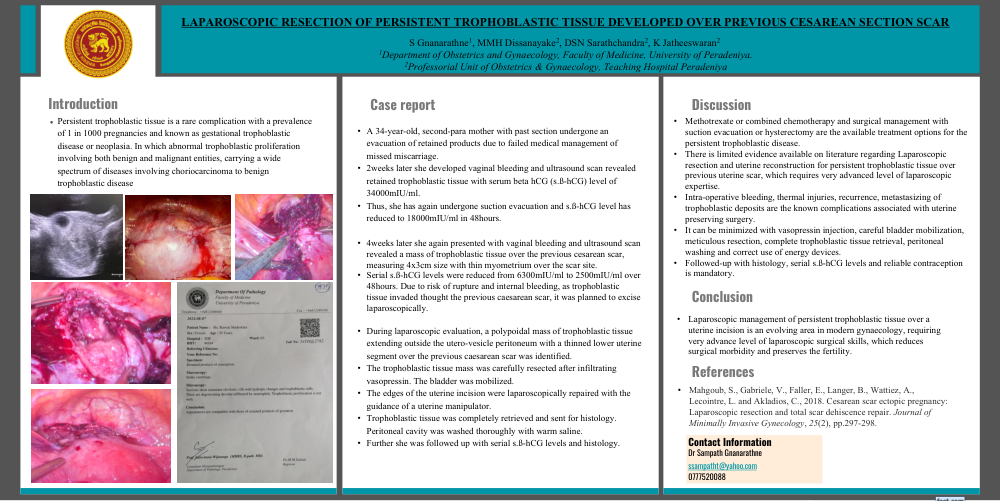
4weeks later she again presented with vaginal bleeding and ultrasound scan
revealed a mass of trophoblastic tissue over the previous cesarean scar,
measuring 4x3cm size with thin myometrium over the scar site.
Serial s.ß-hCG levels were reduced from 6300mIU/ml to 2500mIU/ml over
48hours. Due to risk of rupture and internal bleeding, as trophoblastic
tissue invaded thought the previous caesarean scar, it was planned to excise
laparoscopically.
During laparoscopic evaluation, a polypoidal mass of trophoblastic tissue
extending outside the utero-vesicle peritoneum with a thinned lower uterine
segment over the previous caesarean scar was identified.
The trophoblastic tissue mass was carefully resected after infiltrating
vasopressin. The bladder was mobilized.
The edges of the uterine incision were laparoscopically repaired with the
guidance of a uterine manipulator.
Trophoblastic tissue was completely retrieved and sent for histology.
Peritoneal cavity was washed thoroughly with warm saline.
Further she was followed up with serial s.ß-hCG levels and histology.
Discussion
Methotrexate or combined chemotherapy and surgical management with
suction evacuation or hysterectomy are the available treatment options for the
persistent trophoblastic disease.
There is limited evidence available on literature regarding Laparoscopic
resection and uterine reconstruction for persistent trophoblastic tissue over
previous uterine scar, which requires very advanced level of laparoscopic
expertise.
Intra-operative bleeding, thermal injuries, recurrence, metastasizing of
trophoblastic deposits are the known complications associated with uterine
preserving surgery.
It can be minimized with vasopressin injection, careful bladder mobilization,
meticulous resection, complete trophoblastic tissue retrieval, peritoneal
washing and correct use of energy devices.
Followed-up with histology, serial s.ß-hCG levels and reliable contraception
is mandatory.
Conclusion
Laparoscopic management of persistent trophoblastic tissue over a
uterine incision is an evolving area in modern gynaecology, requiring
very advance level of laparoscopic surgical skills, which reduces
surgical morbidity and preserves the fertility.
Reference
Mahgoub, S., Gabriele, V., Faller, E., Langer, B., Wattiez, A.,
Lecointre, L. and Akladios, C., 2018. Cesarean scar ectopic pregnancy:
Laparoscopic resection and total scar dehiscence repair. Journal of
Minimally Invasive Gynecology, 25(2), pp.297-298.