2,281 posters, 63 videos, 56 audios, 43 topics, 18 sessions, 6,174 authors, 2,323 institutions
ePostersLive by SciGen Technologies S.A. All rights reserved.
RCOG World Congress 2025
June 23 - 25, 2025 | ExCeL London, UK
EP.1167
Uterine Transplantation Surgical Framework: How to progress beyond the experimental
Poster Presenter
Authors
Margherita Bielli, Ariadne L'Heveder, Saaliha Vali, Srdjan Saso, Timothy Bracewell-Milnes, Meen Yau Thum, James Nicopoullos, Isabel Quiroga, Liza Johannesson, J Richard Smith, Benjamin P Jones
Affiliations
Imperial College London, Oxford University Hospitals NHS Foundation Trust, Lister Fertility Clinic, Imperial College NHS Healthcare Trust, Annette C. and Harold C. Simmons Transplant Institute Baylor University Medical Center
Part of Topic
Hot topics (emerging research/issues) in gynaecology
Uterine transplantation surgical framework: How to progress beyond the experimental
Margherita Bielli1,2, Ariadne L’Heveder1,2,3, Srdjan Saso1,2, Bracewell-Milnes T6, Thum MY,2,6, Nicopoullos6, Liza Johannesson4, Isabel Quiroga5, J Richard Smith1,2, Benjamin P Jones1,2,6
1 Department of Gynaecology, Hammersmith Hospital, Imperial College NHS Trust, London, W12 OHS London, UK., 2 Department of Metabolism, Digestion and Reproduction, Imperial College London, Du Cane Road, London W12 0NN, UK., 3 Cutrale Perioperative and Ageing Group, Department of Engineering, Imperial College London, St Mary’s Campus, London W2 1PG 4 Baylor University Medical Centre, 75246-2088, Dallas, Texas. 5 The Oxford Transplant Centre, The Churchill Hospital, Oxford University Hospitals NHS Trust, Old Road, Oxford, OX3 7LE. 6 Lister Fertility Clinic, The Lister Hospital, Chelsea Bridge Road, London, SW1W 8RH
INTRODUCTION
Uterine transplantation (UTx) has been increasingly performed worldwide with over 100 UTx and 50 livebirths worldwide .
For UTx to be made more widely available to individuals with absolute uterine factor infertility (AUFI), it needs to progress from an experimental research procedure to an established clinical treatment.
OBJECTIVES
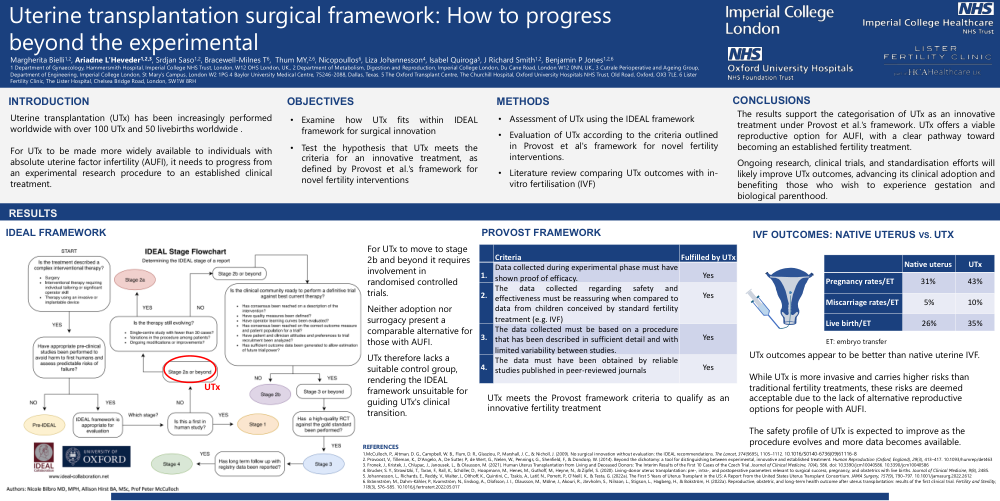
For UTx to move to stage 2b and beyond it requires involvement in randomised controlled trials.
Neither adoption nor surrogacy present a comparable alternative for those with AUFI.
UTx therefore lacks a suitable control group, rendering the IDEAL framework unsuitable for guiding UTx's clinical transition.
Provost framework
UTx meets the Provost framework criteria to qualify as an innovative fertility treatment
IVF outcomes: Native UTERUS vs. UTx
UTx outcomes appear to be better than native uterine IVF.
While UTx is more invasive and carries higher risks than traditional fertility treatments, these risks are deemed acceptable due to the lack of alternative reproductive options for people with AUFI.
The safety profile of UTx is expected to improve as the procedure evolves and more data becomes available.
The results support the categorisation of UTx as an innovative treatment under Provost et al.'s framework. UTx offers a viable reproductive option for AUFI, with a clear pathway toward becoming an established fertility treatment.
Ongoing research, clinical trials, and standardisation efforts will likely improve UTx outcomes, advancing its clinical adoption and benefiting those who wish to experience gestation and biological parenthood.