2,281 posters, 63 videos, 56 audios, 43 topics, 18 sessions, 6,174 authors, 2,323 institutions
ePostersLive by SciGen Technologies S.A. All rights reserved.
RCOG World Congress 2025
June 23 - 25, 2025 | ExCeL London, UK
EP.1165
Evaluating Post-operative Wound Infections In patients Undergoing Major Laparotomy Procedures In Gynaecology
Poster Presenter
Part of Topic
Hot topics (emerging research/issues) in gynaecology
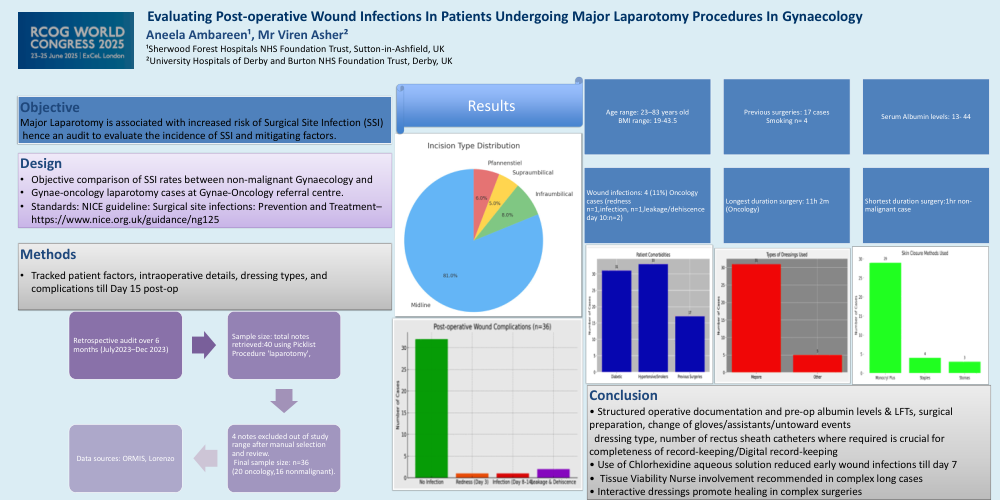
Objective:Major Laparotomy is associated with increased risk of Surgical Site Infection (SSI)hence an audit of such cases to evaluate the incidence of SSI and mitigating factors.
Design:Objective comparison of rates of surgical wound infections between non-malignant Gynaecology laparotomy and Gynae-oncology laparotomy cases at Gynae-oncology referral centre.Standards used: NICE guideline:Surgical site infections:Prevention and Treatment.https://www.nice.org.uk/guidance/ng125
Methods: Retrospective Audit.Duration:6 months:July 2023-Dec 2023.Sample size:total notes retrieved:40 using Picklist Procedure 'laparotomy', 4 notes excluded out of study range after Manual selection and review,final n=36.Data collection forms using data applications:ORMIS,Lorenzo.Patient journey through pre-operative, intra-operative and post-operative phase tracked till Day 15 post-op, evaluating factors as BMI,pre-op investigatios, previous surgery/site,co-morbidities,length of procedure,abdominal preparation,intraprocedure untoward events,use of drains/ rectus sheath catheters and dressing types.
Results: Of the 36 notes retrieved, Oncology=20,non-malignant=16, age range:23-83years.Lowest BMI:19.5-Oncology, highest 43.5-non-malignant case.17 cases= previous surgeries, 31=diabetic,33=hypertensive and smokers. Serum Albumin levels were requested in 25 cases pre-op: lowest albumin=13 for Oncology,highest= 44 for non-malignant laparotomy.3 of Oncology patients had received previous chemotherapy cycles.Commonest procedure: staging laparotomy(n=15)4 Ultra-Radical surgeries,4 delayed debulking procedures,4 TAH+BSO,1 non-malignant case converted to laparotomy.Longest duration of procedure=11h2m Oncology, shortest=1hr non-malignant.Intra-op:Skin prep mostly done by combination of Clorhexedine Pink 0.5% in IMS 70%+ Povidone10% solution(n=17).Commonest incision type:Midline(81%) 8%infraumbilical,5% supraumbilical,6% Pfennenstial incision.Skin closure by Monocryl plus=29cases,staples=4,stomas=3.Commonly used:2rectus sheath catheters+single drain in 13 Oncology cases.Mepore dressing mostly used in 31cases.Post-op:4wound infections(11%)1 Oncology case showed signs of wound redness on Day3 postop,no further sequelae.1 Oncology case:clinical wound infection Day 8-14, warranting change of dressing and starting of antibiotics.2 Oncology cases had anastomotic leakage and abdominal wall dehiscence on Day 10.
Conclusion:For Audit purposes:Structured full documentation of operative notes, surgical preparation,change of gloves/assistants/untoward events and management used,dressing type, number of rectus sheath catheters where required is crucial for completeness of record-keeping.Perhaps digitalization of Gynaecology services to mitigate human factors and service evaluation is required.For Clinical purposes.Pre-op bloods to include serum Albumin levels regularly with LFTs. Use of Chlorhexeidien aqeous solution shown to have no immediate wound infection till 7days post-op.Interactive dressings with low-adherent absorbent pad and bacterial barrier film allow wound healing process through the creation and maintenance of a local, warm, moist environment.Regular wound assessment and use of Tissue Viability Nursing care in complex prolonged surgeries.