2,281 posters, 63 videos, 56 audios, 43 topics, 18 sessions, 6,174 authors, 2,323 institutions
ePostersLive by SciGen Technologies S.A. All rights reserved.
RCOG World Congress 2025
June 23 - 25, 2025 | ExCeL London, UK
EP.1161
Solving the Gynaecology Waiting-List Crisis: A Case for the One-Stop Clinic
Poster Presenter
Authors
Affiliations
Part of Topic
Hot topics (emerging research/issues) in gynaecology
Solving the Gynaecology Waiting-List Crisis: A Case for the One-Stop Clinic
Nazia Zahed1, Josephine Sandwell1
1Guy’s and St Thomas’ Hospital NHS Trust, London, UK
Objectives:
To evaluate current care pathways in the gynaecology outpatient department (GOPD).
Background:
Despite the UK government’s publication of the Women’s Health Strategy in 2022, waiting times in non-cancer gynaecology have continued to rise.
In 2024, the RCOG described gynaecology waiting-lists in the UK to be in crisis, as women routinely waited months-to-years for their appointment.
As patients report an associated decline in wellbeing, healthcare professionals also feel overburdened trying to meet demands.
To help shorten referral-to-treatment-time (RTT), the ‘Getting It Right First Time’ (GIRFT) national programme promotes use of ‘One-stop’ assessment in several specialties. Our team aimed to explore this locally.
Methods:
Retrospective review of patients attending the general, non-cancer GOPD at a single tertiary hospital in central London in 2024. Patient lists were sampled from 5 clinics.
A One-stop clinic with same-day pelvic ultrasound and minor procedures by the consulting clinician was simultaneously piloted, with prospective data collection from 6 clinics.
Data was collected on presenting complaint(s), waiting times, grade of doctor seen, treatment started, and appointment outcome(s).
Results:
Conventional GOPD:
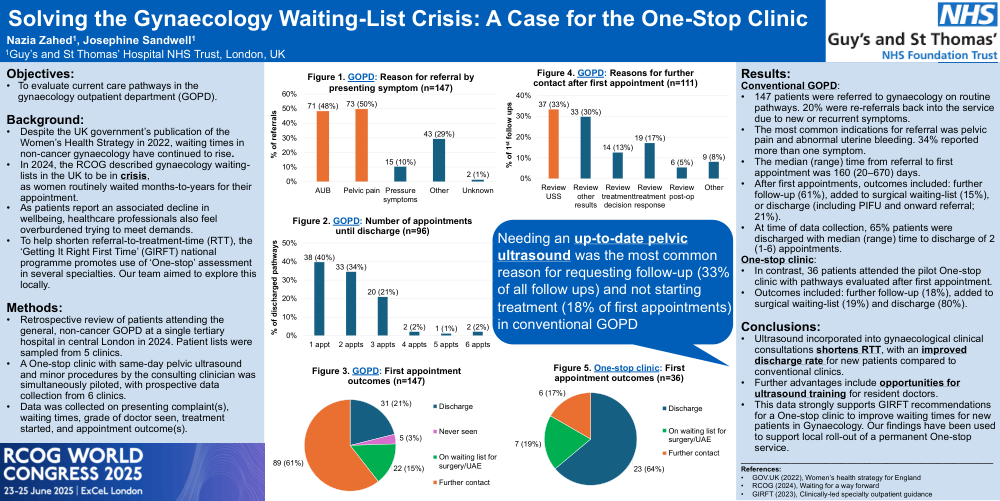
147 patients were referred to gynaecology on routine pathways. 20% were re-referrals back into the service due to new or recurrent symptoms.
The most common indications for referral was pelvic pain and abnormal uterine bleeding. 34% reported more than one symptom.
The median (range) time from referral to first appointment was 160 (20–670) days.
After first appointments, outcomes included: further follow-up (61%), added to surgical waiting-list (15%), or discharge (including PIFU and onward referral; 21%).
At time of data collection, 65% patients were discharged with median (range) time to discharge of 2 (1-6) appointments.
Needing an up-to-date pelvic ultrasound was the most common reason for requesting follow-up (33% of all follow ups) and not starting treatment (18% of first appointments) in conventional GOPD
One-stop clinic:
In contrast, 36 patients attended the pilot One-stop clinic with pathways evaluated after first appointment.
Outcomes included: further follow-up (18%), added to surgical waiting-list (19%) and discharge (80%).
Conclusions:
Ultrasound incorporated into gynaecological clinical consultations shortens RTT, with an improved discharge rate for new patients compared to conventional clinics.
Further advantages include opportunities for ultrasound training for resident doctors.
This data strongly supports GIRFT recommendations for a One-stop clinic to improve waiting times for new patients in Gynaecology. Our findings have been used to support local roll-out of a permanent One-stop service.
References:
GOV.UK (2022), Women’s health strategy for England
RCOG (2024), Waiting for a way forward
GIRFT (2023), Clinically-led specialty outpatient guidance