1,830 posters, 67 videos, 75 audios, 29 topics, 22 sessions, 4,727 authors, 1,697 institutions
ePostersLive by SciGen Technologies S.A. All rights reserved.
RCOG World Congress 2023
June 12 - 14, 2023 | London, UK

EP.0995
Systematic review of national guidelines for iron deficiency anaemia in pregnancy.
Poster Presenter
Authors
Affiliations
Part of Topic
Quality Improvement
Objective:
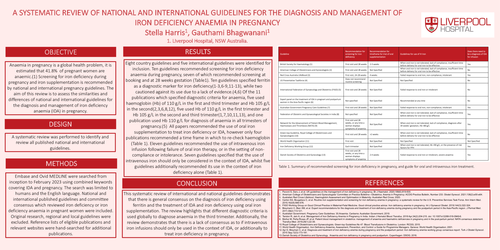
Anaemia in pregnancy is a global health problem, it is estimated that 41.8% of pregnant women are anaemic.(1) Screening for iron deficiency during pregnancy and iron supplementation is recommended by national and international pregnancy guidelines. The aim of this review is to assess the similarities and differences of national and international guidelines for the diagnosis and management of iron deficiency anaemia (IDA) in pregnancy.
Design:
A systematic review was performed to identify and review all published national and international guidelines.
Methods:
Embase and Ovid MEDLINE were searched from inception to February 2023 using combined keywords covering IDA and pregnancy. The search was limited to humans and the English language. National and international published guidelines and committee consensus which reviewed iron deficiency or iron deficiency anaemia in pregnant women were included. Original research, regional and local guidelines were excluded. Reference lists of eligible publications and relevant websites were hand-searched for additional publications.
Results:
Eight country guidelines and five international guidelines were identified for inclusion. Ten guidelines recommended screening for iron deficiency anaemia during pregnancy, seven of which recommended screening at booking and at 28 weeks gestation (Table1). Ten guidelines specified ferritin as a diagnostic marker for iron deficiency(1-3,6-9,11-13), while two cautioned against its use due to a lack of evidence.(4,6) Of the 11 publications which specified diagnostic criteria for anaemia, five used haemoglobin (Hb) of 110 g/L in the first and third trimester and Hb 105 g/L in the second(2,3,6,8,12), five used Hb of 110 g/L in the first trimester and Hb 105 g/L in the second and third trimester(1,7,10,11,13), and one publication used Hb 110 g/L for diagnosis of anaemia in all trimesters of pregnancy.(5) All papers recommended the use of oral iron supplementation to treat iron deficiency or IDA, however only four publications recommended a time frame in which to re-check haemoglobin (Table 1). Eleven guidelines recommended the use of intravenous iron infusion following failure of oral iron therapy, or in the setting of non-compliance or intolerance. Seven guidelines specified that the use of intravenous iron should only be considered in the context of IDA, whilst five guidelines additionally recommended its use in the context of iron deficiency alone (Table 1).
Conclusion:
This systematic review of international and national guidelines demonstrates that there is general consensus on the diagnosis of iron deficiency using ferritin and the treatment of IDA and iron deficiency using oral iron supplementation. The review highlights that different diagnostic criteria is used globally to diagnose anaemia in the third trimester. Additionally, the review demonstrates that there is a lack of consensus as to if intravenous iron infusions should only be used in the context of IDA, or additionally to treat iron deficiency in pregnancy.