1,830 posters, 67 videos, 75 audios, 29 topics, 22 sessions, 4,727 authors, 1,697 institutions
ePostersLive by SciGen Technologies S.A. All rights reserved.
RCOG World Congress 2023
June 12 - 14, 2023 | London, UK

EP.0994
Impact of Perineal Protection Interventions to Reduce Obstetric Anal Sphincter Injury Incidence
Poster Presenter
Authors
Affiliations
Part of Topic
Quality Improvement
Audio
Impact of Perineal Protection Interventions to Reduce Obstetric Anal Sphincter Injury Incidence
AUTHOR(S): Dr Charlotte Officer1 & Dr Nishamini Subramaniam1,2
1Macquarie University Clinical School, Northern Beaches Hospital, Sydney, Australia
2Department of Obstetrics and Gynaecology, Northern Beaches Hospital, Sydney, Australia
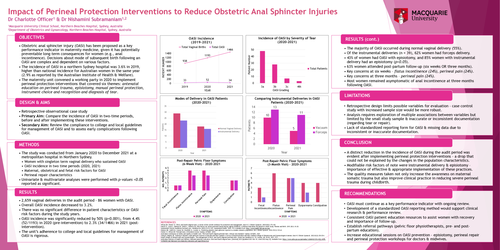
Objective: Obstetric anal sphincter injury (OASI) has been proposed as a key performance indicator in maternity medicine given it has potentially preventable long-term consequences for women such as anal incontinence. Decisions about mode of subsequent birth following an OASI are complex and dependent on various factors. The incidence of OASI in our northern Sydney hospital was 3.6% in 2019, and higher than national incidence for Australian women in the same year (2.9% as reported by the Australian Institute of Health and Welfare). The maternity unit convened a working party in 2020 to implement perineal protection interventions that covered six themes: antenatal education on perineal trauma, episiotomy, manual perineal protection, instrument choice and recognition and diagnosis of tear. Our primary aim is to compare the incidence of OASI in two-time periods, before and after implementing these interventions. The secondary aims were to review the compliance to college and local guidelines for management of OASI and to assess early complications following OASI.
Design: Retrospective observational study
Methods: The study was conducted from January 2020 to December 2021 at a metropolitan hospital in Northern Sydney, consisting of women with singleton term vaginal delivery who sustained OASI. The incidence of OASI in two time periods, maternal, obstetrical and fetal risk factors for OASI and perineal repair characteristics was collected from the hospital obstetric database. Univariate and multivariate analyses were performed with p-values <0.05 reported as significant.
Results: A total of 2,659 vaginal deliveries occurred in the audit period with 86 women sustaining OASI. During the two-year study period from 2020 to 2021, the overall incidence of OASI decreased to 3.2%. OASI incidence was significantly reduced by 50% (p<0.001), from 4.4% (52/1193) in 2020 (pre-intervention) to 2.3% (34/1466) in 2021 (post-intervention). There was no significant difference in patient characteristics or OASI risk factors during the study years. The unit’s adherence to college and local guidelines for management of OASI is rigorous. Most women remained asymptomatic of anal incontinence at three months following OASI.
Conclusion: During the short study period, a distinct reduction in the incidence of OASI was evident in women after implementing the interventions for perineal protection, a drop that could not be explained by the changes in the population characteristics. These findings indicate that the quality measures taken not only increase the awareness on maternal somatic trauma but also improve clinical practice in reducing severe perineal trauma during childbirth.