1,830 posters, 67 videos, 75 audios, 29 topics, 22 sessions, 4,727 authors, 1,697 institutions
ePostersLive by SciGen Technologies S.A. All rights reserved.
RCOG World Congress 2023
June 12 - 14, 2023 | London, UK

EP.0988
The Role of Vernacular Knowledge in Women’s Contraceptive Decision-Making
Poster Presenter
Authors
Affiliations
Part of Topic
Sexual Health and Contraception
Audio
The Role of Vernacular Knowledge in Women’s Contraceptive Decision-Making
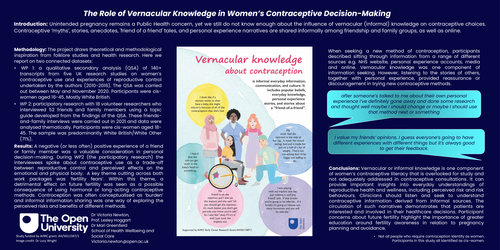
Introduction: Unintended pregnancy remains a Public Health concern, yet we still do not know enough about the influence of vernacular (informal) knowledge on contraceptive choices. Contraceptive ‘myths’, stories, anecdotes, 'friend of a friend' tales, and personal experience narratives are shared informally among friendship and family groups, as well as online.
Methodology: The project draws theoretical and methodological inspiration from folklore studies and health research. Here we report on two connected datasets:
Results: A negative (or less often) positive experience of a friend or family member was a valuable consideration in personal decision-making. During WP2 (the participatory research) the interviewees spoke about contraceptive use as a trade-off between reproductive control and perceived effects on the emotional and physical body. A key theme cutting across both work packages was ‘fertility fears’. Within this theme, a detrimental effect on future fertility was seen as a possible consequence of using hormonal or long-acting contraceptive methods. Contraception was often conceptualised as ‘burden’ and informal information sharing was one way of exploring the perceived risks and benefits of different methods.
When seeking a new method of contraception, participants described sifting through information from a range of different sources e.g. NHS website, personal experience accounts, media and online. Vernacular knowledge was one component of information seeking. However, listening to the stories of others, together with personal experience, provided reassurance or discouragement in trying new contraceptive methods.
"after someone’s talked to me about their own personal experience I’ve definitely gone away and done some research and thought well maybe I should change or maybe I should use that method next or something"
"I value my friends’ opinions. I guess everyone’s going to have different experiences with different things but it’s always good to get their feedback"
Conclusions: Vernacular or informal knowledge is one component of women’s contraceptive literacy that is overlooked for study and not adequately addressed in contraceptive consultations. It can provide important insights into everyday understandings of reproductive health and wellness, including perceived risk and risk behaviours. Clinicians should listen and seek to understand contraceptive information derived from informal sources. The circulation of such narratives demonstrates that patients are interested and involved in their healthcare decisions. Participant concerns about future fertility highlight the importance of greater education around fertility awareness in relation to pregnancy planning and avoidance.