1,830 posters, 67 videos, 75 audios, 29 topics, 22 sessions, 4,727 authors, 1,697 institutions
ePostersLive by SciGen Technologies S.A. All rights reserved.
RCOG World Congress 2023
June 12 - 14, 2023 | London, UK

EP.0094
Establishing Singhealth Maternal Medicine Network: A Multidisciplinary Specialist Service for Obstetric Patients
Poster Presenter
Part of Topic
Quality Improvement
Establishing a SinghealthMaternal Medicine Network (SMMN): A Multidisciplinary Specialist Care Service for High Risk Obstetric Patients
Toh Wuen Lynn1, Ryan Lee Wai Kheong2, Serene Thain Pei Ting2, Tan Lay Kok2
Department of Obstetrics and Gynecology, KKH, Singapore1
Department of Maternal Fetal Medicine, KKH, Singapore2
Introduction
Currently in Singapore, there is no established multidisciplinary network for the care of complex high risk obstetrics patients. As such, some obstetric patients with pre-existing medical conditions are often managed by their respective specialists with no interdisciplinary discussion. Care of such patients may be compromised or even delayed. Medical issues may also develop in the antenatal period which may require input from different specialities or even an inter-hospital transfer. The presence of SMMN can expedite the transfer and promote collegiality among different specialities to allow formulation of multidisciplinary recommendations together on the management of complex medical disorders in pregnancy.
Within SingHealth, there are multidisciplinary clinics combining Obstetrics and Internal Medicine (IM) care like STORK (one Stop Obstetric High Risk centre) in KK Women's and Children's Hospital (KKWCH) and CHiRP (Centre for High Risk Pregnancies) in Singapore General Hospital (SGH) that provide multidisciplinary joint care of pregnant patients with certain long-standing chronic medical conditions like hypertension, diabetes mellitus, cardiovascular and renal disease. Obstetrics and gynaecological (O&G) services in KKWCH and SGH are already working closely together under the Singhealth OBGYN Academic Clinical Programme. The multidisciplinary medical specialties are also very ably supported by physicians from both Tan Tock Seng Hospital (TTSH) and SGH.
However, in the recent years, we are seeing an increasing case mix of high-risk pregnancies presenting with a variety of medical conditions. This is also in keeping with the older average age of pregnant women, the increasing prevalence of overweight, obesity and diabetes, the uptake of assisted reproductive treatment, and advances in medicine allowing women with chronic and congenital medical conditions to reach reproductive age. Often, maternal morbidity and mortality rates are consequential of complex medical disorders often exacerbated during pregnancy. In a study done by Nair et al, they reported an almost nine fold increase in odds of maternal death among women with pre-existing medical condition compared with women who did not in the United Kingdom. The odds of maternal death also increased linearly by 6% per year increase in maternal age after adjusting for the other risk factors for maternal death. They identified a few risk factors for maternal death with the most important ones being the presence of medical comorbidities, maternal age ≥30 years and inadequate use of antenatal care services.
While our current arrangement has worked very well for outpatient management in the pre-pregnancy, prenatal and postnatal settings, there is a need to expand this model to encompass a wider coverage including inpatient and acute care. Examples include women who develop pulmonary oedema, cardiomyopathy, massive pulmonary embolism, acute pancreatitis, diabetic ketoacidosis, amniotic fluid embolism to name a few. These high risk conditions require prompt recognition and intervention on a well-coordinated multidisciplinary and interprofessional level, and often requires inter-hospital transfer usually from KKWCH to SGH when interventions such as dialysis, ECMO or complex surgeries are required. International recommendations addressing this very specific area of women’s health include the formation of multidisciplinary cross network of specialists and allied health care professionals from various disciplines collaborating together to form a Maternal Medicine Network.
As such, we hope to establish a SinghealthMaternal Medicine Network (SMMN). This will be an integrated service to complement Obstetrics by incorporating multidisciplinary speciality services from the various subspecialties in Internal Medicine, Anaesthesia, Critical Care, Interventional Radiology, Neonatology, Surgery etc. from KKH, SGH and TTSH. It is our hope and belief that by giving a name and structure, it can enhance and improve what we already do in terms of multidisciplinary care in our daily clinical work.
Objectives & Methods
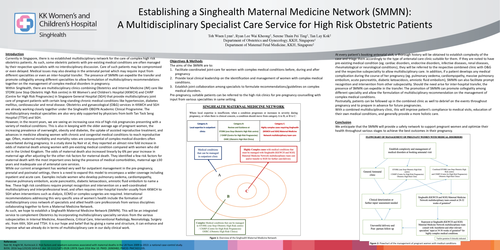
The aims of the SMMN are to:
Pre-pregnancy, suitable patients can be referred to the high risk clinics for pre-pregnancy counselling with input from various specialities in same setting.
At every patient’s booking antenatal visit, a thorough history will be obtained to establish complexity of the case and triage them accordingly to the type of antenatal care clinic suitable for them. If they are noted to have pre-existing medical condition (eg. cardiac disorders, endocrine disorders, infective diseases, renal diseases, rheumatological or neurological conditions), they will be referred to the respective combined clinic with O&G and the respective subspeciality to allow multidisciplinary care. In addition, if a patient develops any medical complication during the course of her pregnancy (eg. pulmonary oedema, cardiomyopathy, massive pulmonary embolism, acute pancreatitis, diabetic ketoacidosis, amniotic fluid embolism), SMMN can also facilitate prompt recognition and intervention from other subspeciality. Should the need arise for inter-hospital transfer, the presence of SMMN can expedite in the transfer. The promotion of SMMN can promote collegiality among different speciality and allow the formulation of multidisciplinary recommendation on the management of complex medical conditions.
Postnatally, patients can be followed up in the combined clinic as well to debrief on the events throughout pregnancy and to prepare in advance for future pregnancies.
With a combined multidisciplinary clinic, this will improve patient’s compliance to medical visits, education of their own medical conditions, and generally provide a more holistic care.
Conclusion
We anticipate that the SMMN will provide a safety network to support pregnant women and optimize their health throughout various stages to achieve the best outcomes in their pregnancy.