1,830 posters, 67 videos, 75 audios, 29 topics, 22 sessions, 4,727 authors, 1,697 institutions
ePostersLive by SciGen Technologies S.A. All rights reserved.
RCOG World Congress 2023
June 12 - 14, 2023 | London, UK

EP.0089
Mentoring for Yorkshire Obstetrics and Gynaecology trainees: an update
Poster Presenter
Part of Topic
Medical Education
Objective
Why is mentoring important?
Mentoring is advised by RCOG for all doctors in training.
It helps to building relationships to create a cohesive workforce and thus improve patient care.
Benefits for both mentee & mentor.
For the mentee, mentoring can enhance ability and improve confidence and job performance, whilst allowing mentors to further develop personal skills including empathy, insight, leadership, and enhanced communication.
O&G is a highly demanding and pressured speciality with high rates of attrition. A successful mentoring scheme could help to reduce this.
Design and Method
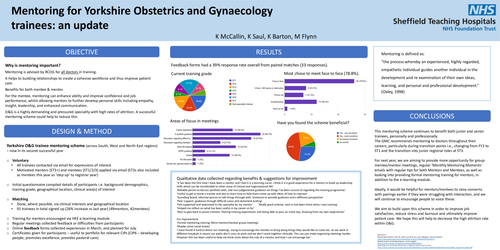
Yorkshire O&G trainee mentoring scheme (across South, West and North East regions) – now in its second successful year
Qualitative data collected regarding benefits & suggestions for improvement
‘It has been the first time I have been a mentor and I feel it is a learning curve. I think it is a good experience for a mentor to build up leadership skills which can be transferable to other areas of clinical and organisational life’
‘Reliable person to discuss portfolio with, and non-judgemental guidance on things I’ve been unsure of regarding the training programme.’
‘Useful to get to know a trainee and also to learn how to help them come up with ideas of how to improve’
‘Sounding board, informal person to talk things through with. Someone to provide guidance and a different perspective’
‘Peer support, guidance through difficult cases and statement writing’
‘Felt supported and welcomed to the speciality by my mentor’ ‘Really good scheme, wish it had been there when I was training’
‘Helped me reflect on what has been useful in my career so far’
’Nice to give back to junior trainees. Sharing training experiences and being able to pass on some tips, drawing from my own experiences’
For improvement:
‘Formal mentoring training. More mentor/mentee group meetings.’
‘Maybe some social events’
‘I have found it hard to direct our meetings, trying to encourage the mentee to bring along things they would like to cover etc. As we work in different hospitals it means our paths don’t cross at work and we don’t work together clinically. This can just make organising meetings harder. However this has been useful to help me think more about the role of a mentor and how I can encourage her.’
Mentoring is defined as:
“the process whereby an experienced, highly regarded, empathetic individual guides another individual in the development and re-examination of their own ideas, learning, and personal and professional development.”
(Oxley, 1998)
Conclusions
This mentoring scheme continues to benefit both junior and senior trainees, personally and professionally.
The GMC recommends mentoring to doctors throughout their careers, particularly during transition points i.e., changing from FY2 to ST1 and the transition into junior registrar roles at ST3.
For next year, we are aiming to provide more opportunity for group mentee/mentor meetings, regular ‘Monthly Mentoring Moments’ emails with regular tips for both Mentors and Mentees, as well as looking into providing formal mentoring training for mentors, in addition to the e-learning module.
Ideally, it would be helpful for mentors/mentees to raise concerns with pairings earlier if they were struggling with interaction, and we will continue to encourage people to voice these.
We aim to build upon this scheme in order to improve job satisfaction, reduce stress and burnout and ultimately improve patient care. We hope this will help to decrease the high attrition rate within O&G.