1,830 posters, 67 videos, 75 audios, 29 topics, 22 sessions, 4,727 authors, 1,697 institutions
ePostersLive by SciGen Technologies S.A. All rights reserved.
RCOG World Congress 2023
June 12 - 14, 2023 | London, UK

EP.0883
Induction of labour using Dilapan: a single centre experience
Poster Presenter
Authors
Affiliations
Part of Topic
Quality Improvement
Induction of labour using Dilapan: a single centre experience
Caterina Tzitzikalakis, Indranil Dutta
Chesterfield Royal Hospital NHS Trust
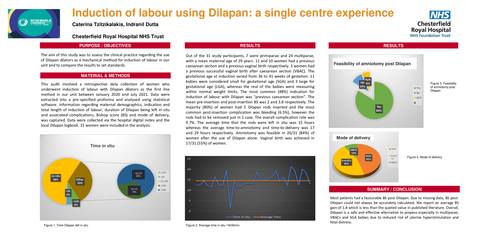
Objective: The aim of this study was to assess the clinical practice regarding the use of Dilapan dilators as a mechanical method for induction of labour in our unit and to compare the results to set standards.
Design: Retrospective study.
Method: This audit involved a retrospective data collection of women who underwent induction of labour with Dilapan dilators as the first line method in our unit between January 2020 and July 2021. Data were extracted into a pre-specified proforma and analysed using statistical software. Information regarding maternal demographics, indication and total length of induction of labour, duration of Dilapan being left in situ and associated complications, Bishop score (BS) and mode of delivery, was captured. Data were collected via the hospital digital notes and the local Dilapan logbook. 31 women were included in the analysis.
Results: Out of the 31 study participants, 7 were primiparae and 24 multiparae, with a mean maternal age of 29 years. 11 and 10 women had a previous caesarean section and a previous vaginal birth respectively. 3 women had a previous successful vaginal birth after caesarean section (VBAC). The gestational age at induction varied from 36 to 41 weeks of gestation. 11 babies were considered small for gestational age (SGA) and 3 large for gestational age (LGA), whereas the rest of the babies were measuring within normal weight limits. The most common (48%) indication for induction of labour with Dilapan was “previous caesarean section”. The mean pre-insertion and post-insertion BS was 2 and 3.8 respectively. The majority (80%) of women had 5 Dilapan rods inserted and the most common post-insertion complication was bleeding (6.5%), however the rods had to be removed just in 1 case. The overall complication rate was 9.7%. The average time that the rods were left in situ was 15 hours whereas the average time-to-amniotomy and time-to-delivery was 17 and 29 hours respectively. Amniotomy was feasible in 26/31 (84%) of women after the use of Dilapan alone. Vaginal birth was achieved in 17/31 (55%) of women.
Conclusions: Most patients had a favourable BS post-Dilapan. Due to missing data, BS post-DIlapan could not always be accurately calculated. We report an average BS gain of 1.8 which is less than the quoted value in published literature. Overall, Dilapan is a safe and effective alternative to propess especially in multiparae, VBACs and SGA babies due to reduced risk of uterine hyperstimulation and fetal distress.