1,830 posters, 67 videos, 75 audios, 29 topics, 22 sessions, 4,727 authors, 1,697 institutions
ePostersLive by SciGen Technologies S.A. All rights reserved.
RCOG World Congress 2023
June 12 - 14, 2023 | London, UK

EP.0842
The use of Robson Classification to Assess Caesarean Section Trends in Libya
Poster Presenter
Authors
Affiliations
Part of Topic
Quality Improvement
Video
The use of Robson Classification to Assess Caesarean Section Trends in Libya
(A hybrid model)
Dr Entisar Emjahid1,2, Prof. Asma Arebi3,4
1Tarhuna Teaching Hospital, Tarhuna, Libya. 2Al-Mergib University/ Faculty of Medicine, Khoms, Libya. 3Tripoli University Hospital, Tripoli, Libya. 4Tripoli University/ Faculty of Medicine, Tripoli, Libya
Introduction
This study aimed to reveal how the Robson Ten Group Classification System (TGCS) can be utilized as a common starting point to identify the relative contributions of each of the ten groups to the overall cesarean section (CS) rate and which group accounted for the biggest proportion of women or the group that contributed the most to CS, as well as prospective areas for change in Tarhuna Teaching Hospital (TTH) in Libya. Besides, we aimed to develop a hybrid classification model with additional layers of CS indications to know why they are being performed and to provide recommendations to enhance the quality of care.
Design
In this cross-sectional study, participants were descriptively evaluated according to their obstetric background.
Methodology
Data were collected from the medical records of the maternity department of (TTH) over the year of 2017. Eligible cases were assigned to (TGCS) according to the obstetric criteria. The overall and group-specific CS rate and their contribution to the overall rate were calculated as well as the size of Robson groups. Moreover, the trends in indications for CS in relevant categories of women in the TGCS were calculated. Statistical analysis was conducted by SPSS 22.0 and presented as percentages. Risk Ratios with 95 % confidence intervals (CI), statistical significance was (P < 0.05).
Results
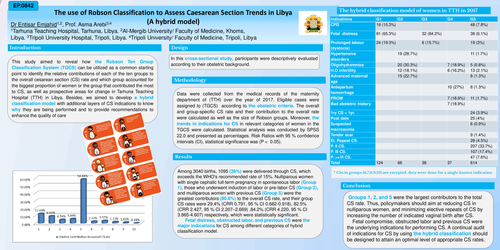
Among 3040 births, 1095 (36%) were delivered through CS, which exceeds the WHO's recommended rate of 15%. Nulliparous women with single cephalic full-term pregnancy in spontaneous labor (Group 1), those who underwent induction of labor or pre-labor CS (Group 2), and multiparous women with previous CS (Group 5) were the greatest contributors (80.6%) to the overall CS rate, and their group CS rates were 29.4% (CRR 0.791, 95 % CI 0.682-0.918), 82.5% (CRR 2.427, 95 % CI 2.207–2.669) ,84.2% (CRR 4.220, 95 % CI 3.865-4.607) respectively, which were statistically significant.
Fetal distress, obstructed labor, and previous CS were the major indications for CS among different categories of hybrid classification model.
Conclusion
Groups 1, 2, and 5 were the largest contributors to the total CS rate. Thus, policymakers should aim at reducing CS in nulliparous women, and minimizing elective repeats of CS by increasing the number of indicated vaginal birth after CS.
Fetal compromise, obstructed labor and previous CS were the underlying indications for performing CS. A continual audit of indications for CS by using the hybrid classification should be designed to attain an optimal level of appropriate CS rates.