1,830 posters, 67 videos, 75 audios, 29 topics, 22 sessions, 4,727 authors, 1,697 institutions
ePostersLive by SciGen Technologies S.A. All rights reserved.
RCOG World Congress 2023
June 12 - 14, 2023 | London, UK

EP.0838
Audit on colposcopy procedure and services: Sri Lanka tertiary care center experience
Poster Presenter
Part of Topic
Quality Improvement
Audit on colposcopy procedure and services: a Sri Lanka tertiary care centre experience
Raguraman S, Muhunthan K, Sukrithan T
Department of Obstetrics and Gynaecology, University of Jaffna
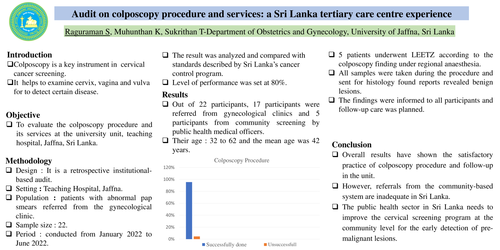
Objective: Aim of this study is to evaluate the colposcopy procedure and its services at the university unit, teaching hospital, Jaffna.
Design: It is a retrospective institutional-based audit, conducted from January 2022 to June 2022 among 22 participants referred from the gynaecological clinic and the community by public health medical officers from the northern part of Sri Lanka.
Method: All of the patients with abnormal pap smears were included in this audit during the study period. Systematic colposcopy assessment was carried out and taken biopsy for indicated patients according to the colposcopy finding. Colposcopy findings were documented and a procedure summary was given to the patients. The result was analyzed and compared with standards described by Sri Lanka’s cancer control program and more than 80% was set as a target of performance. The simple proportion used to draw the analyzed data.
Results: out of 22 participants, 17 participants were referred from gynaecological clinics and 5 participants from community screening by public health medical officers were included in this study. According to the data their age ranges from 32 to 62 and the mean age was 42 years. Almost 95.5% of the participants successfully underwent a complete colposcopy procedure. One colposcopy procedure was abandoned due to poor visualization of the cervix. 5 patients underwent LEETZ according to the colposcopy finding under regional anaesthesia. All samples were taken during the procedure and sent for histology found reports revealed benign lesions. The findings were informed to all participants and follow-up care was planned according to national guidelines.
Conclusion: Colposcopy is an essential procedure to examine abnormal cervical screening.
Overall results have shown the satisfactory practice of colposcopy procedure and follow-up in the unit. However, referrals from the community-based system are inadequate. The public health sector in Sri Lanka needs to improve the cervical screening program at the community level for the early detection of pre-malignant lesions.