1,830 posters, 67 videos, 75 audios, 29 topics, 22 sessions, 4,727 authors, 1,697 institutions
ePostersLive by SciGen Technologies S.A. All rights reserved.
RCOG World Congress 2023
June 12 - 14, 2023 | London, UK

EP.0078
Reducing Surgical Site Infections Post- Caesarean Section
Poster Presenter
Authors
Affiliations
Part of Topic
Quality Improvement
Audio
Reducing Surgical Site Infections Post- Caesarean Section
Author Michael Magro, MBBS, BSc(Hons), MRCOG, PGCert(Darzi), Consultant Obstetrician & Gynaecologist at Barking, Havering and Redbridge University Hospitals NHS Trust
Objective
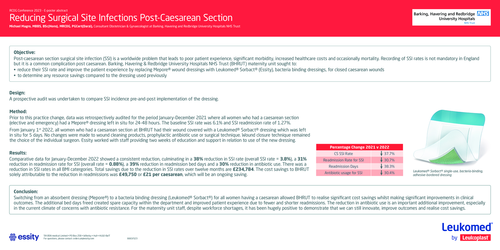
Post-caesarean section surgical site infection (SSI) is a worldwide problem that leads to poor patient experience, significant morbidity, increased healthcare costs and occasionally mortality. Recording of SSI rates is not mandatory in England but it is a common complication post caesarean. Barking, Havering & Redbridge University Hospitals NHS Trust (BHRUT) maternity unit sought to:
- reduce their SSI rate and improve the patient experience by replacing Mepore® wound dressings with Leukomed® Sorbact® (Essity), bacteria binding dressings, for closed caesarean wounds
- to determine any resource savings compared to the dressing used previously
Design
A prospective audit was undertaken to compare SSI incidence pre-and-post implementation of the dressing.
Method
Prior to this practice change, data was retrospectively audited for the period January–December 2021 where all women who had a caesarean section (elective and emergency) had a Mepore® dressing left in situ for 24-48 hours. The baseline SSI rate was 6.1% and SSI readmission rate of 1.27%.
From January 1st 2022, all women who had a caesarean section at BHRUT had their wound covered with a Leukomed® Sorbact® dressing which was left in situ for 5 days. No changes were made to wound cleaning products, prophylactic antibiotic use or surgical technique. Wound closure technique remained the choice of the individual surgeon. Essity worked with staff providing two weeks of education and support in relation to use of the new dressing.
Results
Comparative data for January-December 2022 showed a consistent reduction, culminating in a 38% reduction in SSI rate (overall SSI rate = 3.8%), a 31% reduction in readmission rate for SSI (overall rate = 0.88%), a 39% reduction in readmission bed days and a 30% reduction in antibiotic use. There was a reduction in SSI rates in all BMI catergories. Total savings due to the reduction in SSI rates over twelve months are £234,784. The cost savings to BHRUT solely attributable to the reduction in readmissions was £49,750 or £21 per caesarean, which will be an ongoing saving.
Conclusions:
Switching from an absorbent dressing (Mepore®) to a bacteria binding dressing (Leukomed® Sorbact®) for all women having a caesarean allowed BHRUT to realise significant cost savings whilst making significant improvements in clinical outcomes. The additional bed days freed created spare capacity within the department and improved patient experience due to fewer and shorter readmissions. The reduction in antibiotic use is an important additional improvement, especially in the current climate of concerns with antibiotic resistance. For the maternity unit staff, despite workforce shortages, it has been hugely positive to demonstrate that we can still innovate, improve outcomes and realise cost savings.