1,830 posters, 67 videos, 75 audios, 29 topics, 22 sessions, 4,727 authors, 1,697 institutions
ePostersLive by SciGen Technologies S.A. All rights reserved.
RCOG World Congress 2023
June 12 - 14, 2023 | London, UK

EP.0075
Scoping survey of postpartum contraception (PPC) provision across Europe
Poster Presenter
Part of Topic
Sexual Health and Contraception
Scoping survey of postpartum contraception provision across Europe
Background
Fertility and sexual activity can return quickly in the postpartum period and most pregnancies that occur during the year after childbirth are unintended. The World Health Organisation recommends an interval of at least two years between subsequent pregnancies to reduce the risk of obstetric complications and perinatal death. Increasing focus is being placed on the antenatal and immediate postpartum period as opportune times to initiate contraceptive discussion and provide simplified access to a range of methods while women are still within maternity services. But this is not universally available across Europe and there is a lack of knowledge about the barriers to this.
Aim
Our aim was to conduct a survey of key opinion leaders across Europe about postpartum contraception (PPC) availability to develop a greater understanding of current provision across the region.
Methods
Opinion leaders from each country were identified through existing professional networks of European Society of Contraception and European Board of Obstetrics & Gynaecologists. They were invited to participate in an anonymous online survey consisting of free and fixed-response questions focusing on three key areas: (1) national guidelines/policy (2) antenatal contraceptive discussion and (3) immediate postpartum provision of methods. Respondents were also asked their overall feelings about PPC provision in their region, and any facilitators or barriers.
Results
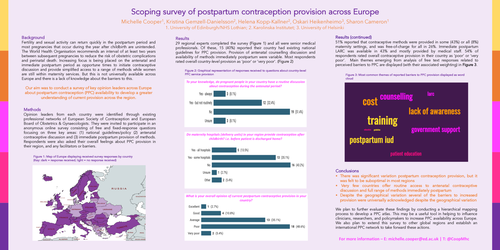
29 regional experts completed the survey (Figure 1) and all were senior medical professionals. Of these, 15 (40%) reported their country had existing national guidelines for PPC provision. Provision of antenatal counselling discussion and availability of methods immediately postpartum were variable. Most respondents rated overall country-level provision as ‘poor’ or ‘very poor’. (Figure 2).
51% reported that contraceptive methods were provided in some (43%) or all (8%) maternity settings, and was free-of-charge for all in 26%. Immediate postpartum LARC was available in 43% and mostly provided by medical staff. 54% of respondents rated overall contraceptive provision in their country as ‘poor’ or ‘very poor’. Main themes emerging from analysis of free text responses related to perceived barriers to PPC are displayed (with their associated weighting) in Figure 3.
Conclusions
We plan to further evaluate these findings by conducting a hierarchical mapping process to develop a PPC atlas. This may be a useful tool in helping to influence clinicians, researchers, and policymakers to increase PPC availability across Europe. We also plan to extend this survey to other global regions and establish an international PPC network to take forward these actions.