1,830 posters, 67 videos, 75 audios, 29 topics, 22 sessions, 4,727 authors, 1,697 institutions
ePostersLive by SciGen Technologies S.A. All rights reserved.
RCOG World Congress 2023
June 12 - 14, 2023 | London, UK

EP.0069
Reproductive healthcare hub for women with learning difficulties at Oxleas NHS Trust
Poster Presenter
Part of Topic
Sexual Health and Contraception
Reproductive Healthcare Hub for women with Learning Difficulties at Oxleas NHS Trust
Dr Shruti Batham, Sharon Rodrigues, Dr Soe Nyunt Aung , Oxleas NHS Foundation Trust
Background
Adult women with learning difficulties (ALD) face challenges accessing routine health care including reproductive, post reproductive healthcare and sexual health. Barriers related to disability make finding an appropriate reproductive healthcare needs difficult.
They may face difficulties with range of cognitive based tasks related to :
- conceptual understanding - social and practical skills
Impact on their daily life depends on :
- severity of intellectual disability - education
- resources - support available
Challenges
Menstrual problems may be experienced more negatively by ALD women and management is challenging.
There may be concerns around :
- menstrual hygiene - cyclical behaviour change
- vulnerability to exploitation - pregnancy
Menopause is usually earlier in ALD women and earlier still for those with Down's syndrome.
Women with learning disabilities have similar physiological experiences, including hot flushes and night sweats, but difficulties in understanding and communication means additional support is often required.
Carers are often poorly trained and resourced to help these women understand the menopause. They may miss these menopause symptoms and may have difficulty in understanding if the physical and psychological problems are from menopausal changes or due to other causes.
Epilepsy is common in people with learning disabilities. Women with catamenial epilepsy (where seizure frequency is related to the menstrual cycle) might experience an increase in seizure frequency in perimenopause and decrease after menopause.
Evidence shows cervical screening uptake is lower in people with learning difficulties compared to the general population.
Objectives
At our reproductive healthcare hub at Oxleas NHS Foundation Trust -a multi-disciplinary (MDT) setting, we provide holistic care with teams including Gynaecology, Sexual and Reproductive health (SRH), Learning difficulties, Mental health team and Auxiliary services.
We manage ALD for :
- menstrual problems - routine support for reproductive well being
- cervical smear - contraceptive need assessment
- routine STI screen - menopause management
Design
We planned to address this through creation of reproductive health easy read leaflets for ALD aiming to improving understanding of gynaecology and SRH issues and access. We aimed to reduce need for multiple appointments making the service efficient.
Methods
Important to make the information easily accessible and understandable for people with learning disabilities.
Visual guides and cues to aid communication is important to have a greater understanding of what is being conveyed.
We devised some easy read leaflets in conjunction with the ALD team at Oxleas. These leaflets are sent prior to their appointment so that the key worker could assist them in reviewing the information.
Results
Working in an MDT team, we have great understanding of the wider team members’ roles and boundaries. We understand responsibility and accountability in decision making and delegation.
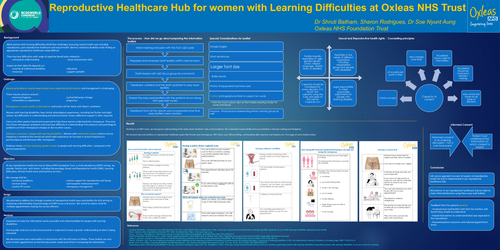
We devised easy read leaflets on reproductive healthcare topics like Periods, peri-menopause, HRT, Pelvic scan, Mirena fitting, contraceptive pills, injection and implants etc. First page of some leafllets included.
Conclusion
- reviewed easy read leaflets with their key workers and found these simple to understand
- helped ALD women to understand what was expected in the consultation
- Improved patient outcomes and reduced appointment times