1,830 posters, 67 videos, 75 audios, 29 topics, 22 sessions, 4,727 authors, 1,697 institutions
ePostersLive by SciGen Technologies S.A. All rights reserved.
RCOG World Congress 2023
June 12 - 14, 2023 | London, UK

EP.0683
A rare case of Arterio-venous malformation of the cervix.
Poster Presenter
Authors
Affiliations
Part of Topic
Imaging in Gynaecology
Title - A rare case of Arterio-venous malformation of the cervix
Objectives
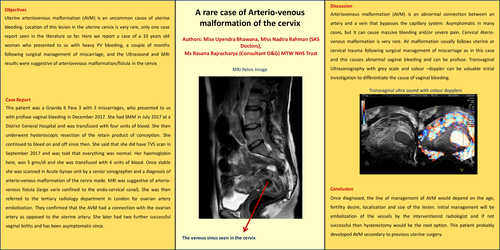
Uterine arteriovenous malformation (AVM) is an uncommon cause of uterine bleeding. Location of this lesion in the uterine cervix is very rare, only one case report seen in the literature so far. Here we report a case of a 33 years old woman who presented to us with heavy PV bleeding, a couple of months following surgical management of miscarriage, and the Ultrasound and MRI results were suggestive of arteriovenous malformation/fistula in the cervix.
Case Report
This patient was a Gravida 6 Para 3 with 3 miscarriages, who presented to us with profuse vaginal bleeding in December 2017. She had SMM in July 2017 at a District General Hospital and was transfused with four units of blood. She then underwent hysteroscopic resection of the retain product of conception. She continued to bleed on and off since then. She said that she did have TVS scan in September 2017 and was told that everything was normal. Her haemoglobin here, was 5 gms/dl and she was transfused with 4 units of blood. Once stable she was scanned in Acute Gynae unit by a senior sonographer and a diagnosis of arterio-venous malformation of the cervix made. MRI was suggestive of arterio-venous fistula (large varix confined to the endo-cervical canal). She was then referred to the tertiary radiology department in London for ovarian artery embolization. They confirmed that the AVM had a connection with the ovarian artery as opposed to the uterine artery. She later had two further successful vaginal births and has been asymptomatic since.
Discussion
Arteriovenous malformation (AVM) is an abnormal connection between an artery and a vein that bypasses the capillary system. Asymptomatic in many cases, but it can cause massive bleeding and/or severe pain. Cervical Aterio-venous malformation is very rare. AV malformation usually follows uterine or cervical trauma following surgical management of miscarriage as in this case and this causes abnormal vaginal bleeding and can be profuse. Transvaginal Ultrasonography with grey scale and colour –doppler can be valuable initial investigation to differentiate the cause of vaginal bleeding.
Conclusion
Once diagnosed, the line of management of AVM would depend on the age, fertility desire, localization and size of the lesion. Initial management will be embolization of the vessels by the interventionist radiologist and if not successful then hysterectomy would be the next option. This patient probably developed AVM secondary to previous uterine surgery.