1,830 posters, 67 videos, 75 audios, 29 topics, 22 sessions, 4,727 authors, 1,697 institutions
ePostersLive by SciGen Technologies S.A. All rights reserved.
RCOG World Congress 2023
June 12 - 14, 2023 | London, UK

EP.0669
Model to teach International Medical Graduate (IMG) trainee to convey 'Empathy'.
Poster Presenter
Authors
Affiliations
Part of Topic
Medical Education
Empathy Teaching Model for International Medical Graduates
B. Patel MBBS, MSc, MD, MRCOG
York and Scarborough Teaching Hospital NHS Foundation Trust
Why reading this is important for educators and IMG doctors?
Evidence suggest that IMG doctors are more likely to be involved in complaints in their first year of training in the UK. Root cause analysis of these complaints identified communication skills as a contributing factors in most of these cases.
It is therefore important to understand not only why this happens and what support the educators could offer to these trainees during their first year of placement in the NHS.
What is Empathy?
Empathy is understanding another person’s feelings or situation and imagining what it might be like to experience these things yourself.
It is important to distinguish empathy from sympathy.
The former is deeper and more involved than the latter, which merely acknowledges another person’s problems or feelings. It involves effective person-to-person communication skills, as well as the ability to understand what another person is feeling.
How is empathy useful in heath care settings?
When a healthcare professional tries to imagine things from the patient’s point of view, it can reveal ways to improve the patient’s care which may not have been considered before. A patient will find it easier to discuss their concerns with somebody who is caring empathetically for them and has taken the time to try to understand what they are going through.
A patient’s feelings, concerns, expectations and ideas are just as important as presenting a physical complaint. By engaging with them, a healthcare professional can better understand these things and ultimately provide better care. Moreover, an empathetic healthcare professional will help to make the patient feel at ease and that they are valued.
What are the types of empathy?
Empathy could be understood when describes in these 3 forms-
Cognitive Empathy
Cognitive empathy is the ability to understand what another person might be thinking or feeling. It need not involve any emotional engagement by the observer.
Cognitive empathy is a mostly rational, intellectual, and emotionally neutral ability.
Emotional Empathy
Emotional empathy is the ability to share the feelings of another person, and so to understand that person on a deeper level. It's sometimes called "affective empathy" because it affects or changes you. It's not just a matter of knowing how someone feels, but of creating genuine rapport with them.
It helps to build trust between the patient and the doctor, and to develop honesty and openness.
But empathy is most valuable when it's combined with action.
Compassionate Empathy
Compassionate empathy is the most active form of empathy. It involves not only having concern for another person, and sharing their emotional pain, but also taking practical steps to reduce it and helping them getting through this situation and preparing for next time.
Why is learning to convey empathy relevant for IMG doctors?
The way and extent to which empathy is taught as part of formal or informal medical curriculum and conveyed in a doctor patient interaction is largely based on cultural norms and expectations that are innate to their country of origin.
Although all medical trainees are subject to this identity transformation once, IMGs when they arrive in the UK are expected to adopt a new professional identity (by altering the old identity) based on new sets of values and behaviors within the context of a new culture.
They do so by going through a period of transition where they view this new culture through the lens of their old culture, learn to identify key differences between them and develop strategies to ‘blend in’. During this phase they would actively look for ways that ‘things are done around here’ and would be very impressionable to the influences of the role models.
Are there more than one type of medical curriculum?
Formal Curriculum is what is covered formally in the course objectives and course materials, and it is what the faculty would teach in a hope that this is what the students would learn. Activities of teaching and learning that happens in a variety of settings like ward round, bedside etc that are largely ad hoc in nature make up Informal Curriculum. Students also learn lessons that are not explicitly intended and at times are contrary to formal curriculum. These lessons form the hidden curriculum. These lessons, most of the times, are a set of survival guide to survive the institution and are embedded in the organisational structure, its culture, norms, and values. They tend to reflect 'the processes, pressures and constraints that fall outside formal curriculum and are often unarticulated and unexplored’. Where HC is literally hidden and operates at organisational cultural level at an unconscious level with an implicit understanding of ‘how things are done here’, Null Curriculum is what gets taught in the way of what is not said or done- ‘this is not how we do things’.
How can an IMG trainee learn to convey empathy when they arrive in the NHS?
Lecture
Although not the principal medium for learning about empathy, a lecture may give some insightful points about the effect that being empathetic has on patients, or ideas for how to go about conducting a good patient interview.
Role modelling
Empathy is intrinsically people-based, and the skill of being empathetic is therefore developed over time spent with people in the role as a doctor. By watching other senior healthcare professionals, doctor may realise any pitfalls in their own approach to interacting with patients.
Communication skills workshops
This traditionally involves an educator and an actor playing out the scenario to a bunch of doctors followed by a lecture on the nuances of communication skills required to convey empathy.
Are these modes good enough?
These models although may provide some means for the IMG doctors to reflect on the differences in ways empathy is conveyed in the context of NHS as compared to their country of origin, none provide an opportunity for the trainee to identify nuances of ‘hidden curriculum’ and thereby an opportunity for guided self-reflection.
Why is addressing hidden curriculum important?
The period of transition has the potential to leave the IMG trainees with positive influences on their new professional identities or it could leave them with identity dissonance leading to stress following exposure to negative aspects of hidden curriculum particularly if they are not managed by timely identification and appropriate reflections.
It is important for the educators to be aware of these influences as there is emerging evidence that negative experiences, if handled correctly by appropriate timely reflections, they have the potential to not only negate any lasting damage to their learning, identity formation or professionalism but also has the potential to impart positive learning.
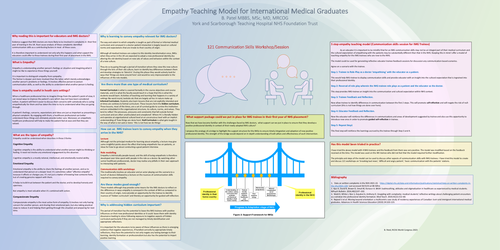
What support package could we put in place for IMG trainee in their first year of NHS placement?
Now that we have become familiar with the challenges faced by IMG doctors, what support can we put in place to ensure that they develop a positive professional identity in context of their newly adopted NHS culture?
I propose the analogy of a bridge to highlight the support structure for the IMGs to ensure timely integration and adoption of new positive professional identity. The strength of the bridge would depend on in-depth understanding of both pillars and effectiveness of each intervention
5 step empathy teaching model (Communication skills session for IMG Trainee)
As an educator it is important to be mindful that for an IMG communication skills may not be an integral part of their medical curriculum and the cultural expectation of empathising with the patients may be substantially different than that in the NHS. Keeping this in mind I offer a model of teaching empathy for the IMG trainees who are new to the NHS.
The model could be used for generating reflective educator trainee feedback sessions for discussion any communication-based scenarios.
Agree on a scenario with the trainee.
Step 1: Trainee to Role-Play as a doctor ‘empathising’ with the educator as a patient.
This would help IMG-trainee to display communication skills and provide educator with an insight into the cultural expectation that is ingrained into their professional identity.
Step 2: Reversal of role play wherein the IMG-trainee role plays as a patient and the educator as the doctor.
This step provides IMG-trainee an insight into the communication and cultural expectation within NHS context.
Step 3: Trainee Feedback and Reflection.
Now allow trainee to identify differences in communication between the first 2 steps. This will promote self-reflection and will negate the risk of null-curriculum (this is not how things are done over here).
Step 4: Educator Feedback and Reflection.
Now the educator will reinforce the differences in communications and areas of development suggested by trainee and also use this opportunity to introduce new ones in order to promote guided self-reflection in trainee.
Step 5: Repeat Step1
This final step will reinforce the learnings accrued by the trainee through Step 3 and 4.
Has this model been trialed in practice?
I have tried the above model with 4 IMG trainees and the feedback from them was very positive. The model was modified based on the feedback received at the time. The model was used on the 4th trainee who did not feel that the model required further modification.
The principle and steps of the model can be used to discuss other aspects of communication skills with IMG trainees. I have tried the model to create and discuss 121 workshops on ‘breaking bad news’, ‘difficult and angry patient’, ‘basic communication with the patients’ stations.
Bibliography
1. Data on written complaints in the NHS 2021-22. https://digital.nhs.uk/data-and-information/publications/statistical/data-on-written-complaints-in-the-nhs/2021-22#. Last accessed 30/5/23 at 08:50hrs
2. Ajaz A, David R, Brown D, Smuk M, Korszun A. BASH: badmouthing, attitudes and stigmatisation in healthcare as experienced by medical students. BJPsych Bulletin. 2016;40(2):97–102.
3. Wald H, White J, Reis S, Esquibel A, Anthony D. Grappling with complexity: medical students’ reflective writings about challenging patient encounters as a window into professional identity formation. Med Teach. 2019;41(2):152–60.
4. Najeed U et al. Moving beyond orientation: a multicentric case study of residency experiences of Canadian- born and immigrant international medical graduates. Advances in Health Sciences Education (2019) 24:103-123.