1,830 posters, 67 videos, 75 audios, 29 topics, 22 sessions, 4,727 authors, 1,697 institutions
ePostersLive by SciGen Technologies S.A. All rights reserved.
RCOG World Congress 2023
June 12 - 14, 2023 | London, UK

EP.0610
Review of Pipelle biopsy outcome + a retrospective study on Postmenopausal proliferative endometrium
Poster Presenter
Authors
Affiliations
Part of Topic
Quality Improvement
Review of Pipelle biopsy outcome + a retrospective study on Postmenopausal proliferative endometrium
D. Hag Mohamed, Clinical fellow ST3 S. Akhtar, Consultant Obstetrics and Gynaecology
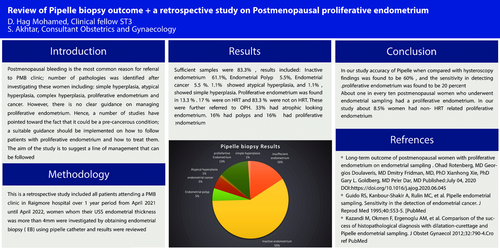
Introduction : Postmenopausal bleeding is the most common reason for referral to PMB clinic; number of pathologies was identified after investigating these women including: simple hyperplasia, atypical hyperplasia, complex hyperplasia, proliferative endometrium and cancer. However, there is no clear guidance on managing proliferative endometrium. Hence, a number of studies have pointed toward the fact that it could be a pre-cancerous condition; a suitable guidance should be implemented on how to follow patients with proliferative endometrium and how to treat them. The aim of the study is to suggest a line of management that can be followed
Methodology : This is a retrospective study included all patients attending a PMB clinic in Raigmore hospital over 1 year period from April 2021 until April 2022, women whom their USS endometrial thickness was more than 4mm were investigated by obtaining endometrial biopsy ( EB) using pipelle catheter and results were reviewed
Results : Sufficient samples were 83.3% , results included: Inactive endometrium 61.1%, Endometrial Polyp 5.5%, Endometrial cancer 5.5 %. 1.1% showed atypical hyperplasia, and 1.1% , showed simple hyperplasia. Proliferative endometrium was found in 13.3 % . 17 % were on HRT and 83.3 % were not on HRT. These were further referred to OPH. 33% had atrophic looking endometrium. 16% had polyps and 16% had proliferative endometrium
Conclusion : In our study accuracy of Pipelle when compared with hysteroscopy findings was found to be 60% , and the sensitivity in detecting proliferative endometrium was found to be 20 percent. About one in every ten postmenopausal women who underwent endometrial sampling had a proliferative endometrium. In our study about 8.5% women had non- HRT related proliferative endometrium