1,830 posters, 67 videos, 75 audios, 29 topics, 22 sessions, 4,727 authors, 1,697 institutions
ePostersLive by SciGen Technologies S.A. All rights reserved.
RCOG World Congress 2023
June 12 - 14, 2023 | London, UK

EP.0606
PATTERN OF UPTAKE AND DISCONTINUATION OF CONTRACEPTIVE IMPLANTS AT FMC ABEOKUTA.
Part of Topic
Sexual Health and Contraception
PATTERN OF UPTAKE AND DISCONTINUATION OF CONTRACEPTIVE IMPLANTS AT FEDERAL MEDICAL CENTRE ABEOKUTA.
AUTHORS
Dr. Badmaasi-Abdulraheem TM, Dr. Alabi OS, Dr. Ade-Onojobi AO, Dr. Oladosu-Aderolu AO, Dr. Ojugbele NM.
ABSTRACT
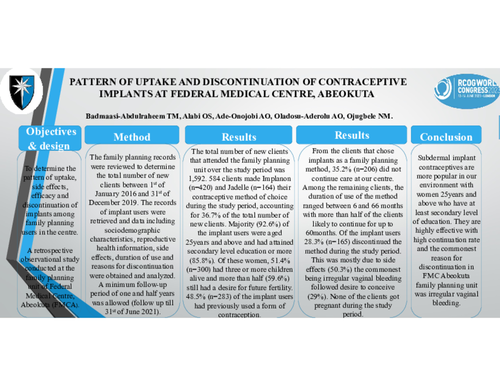
Objectives: The study aimed to determine the pattern of uptake, side effects, efficacy and discontinuation of implants among family planning users in the centre.
Design: It was a retrospective observational study conducted at the family planning unit of Federal Medical Centre, Abeokuta (FMCA).
Method: The family planning records were reviewed to determine the total number of new clients between 1st of January 2016 and 31st of December 2019. The records of implant users were retrieved and data including sociodemographic characteristics, reproductive health information, side effects, duration of use and reasons for discontinuation were obtained and analyzed. A minimum follow-up period of one and half years was allowed (follow up data was obtained on implants users till 31st of June 2021).
Results: The total number of new clients that attended the family planning unit over the study period was 1,592. 584 clients made Implanon (n=420) and Jadelle (n=164) their contraceptive method of choice during the study period, accounting for 36.7% of the total number of new clients. Majority (92.6%) of the implant users were aged 25years and above and had attained secondary level education or more (85.8%). Of these women, 51.4% (n=300) had three or more children alive and more than half (59.6%) still had a desire for future fertility. 48.5% (n=283) of the implant users had previously used a form of contraception. From the clients that chose implants as a family planning method, 35.2% (n=206) did not continue care at our centre. Among the remaining clients, the duration of use of the method ranged between 6 and 66 months with more than half of the clients likely to continue for up to 60months. Of the implant users 28.3% (n=165) discontinued the method during the study period. This was mostly due to side effects (50.3%) the commonest being irregular vaginal bleeding followed by desire to conceive (29%). None of the clients got pregnant during the study period.
Conclusion: Subdermal implant contraceptives are more popular in our environment with women 25years and above who have at least secondary level of education. They are highly effective with high continuation rate and the commonest reason for discontinuation in FMC Abeokuta family planning unit was irregular vaginal bleeding.