1,830 posters, 67 videos, 75 audios, 29 topics, 22 sessions, 4,727 authors, 1,697 institutions
ePostersLive by SciGen Technologies S.A. All rights reserved.
RCOG World Congress 2023
June 12 - 14, 2023 | London, UK

EP.0605
Streamlining referrals to an Out-patient hysteroscopy service
Poster Presenter
Authors
Uloma Okwuosa, Soma Roy-chaudhuri, Sadaf Ahmad, Ahmed Darwish, Shen Chuen Khaw, Elena Plesca
Affiliations
Department of Gynaecology, John Radcliffe Hospital, Oxford University Hospitals NHS Foundation Trustdation Trust, Department of Gynaecology, John Radcliffe Hospital, Oxford University Hospitals NHS Foundation Trust, Royal Berkshire NHS Foundation Trust
Part of Topic
Imaging in Gynaecology
Objectives:
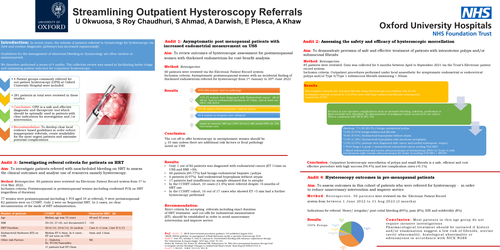
A collective review of 4 audits aimed to highlight the need for better triage and patient selection for Out-patient hysteroscopy.
Methods:
4 Retrospective audits of patient groups commonly referred for out-patient hysteroscopy at Oxford University Hospital.
Patients identified on electronic records system. Data on set-out parameters collected and analysed.
Results:
Guidelines on the management of abnormal bleeding in certain patient groups are often unclear or misinterpreted. These include the premenopausal, post-menopausal women on HRT and asymptomatic post-menopausal patients with thiackened endometrium on USS.
Our audits of these groups of women aim to assess referral criteria and outcomes so as to clarify our local guidelines.
281 patients in total were included in these studies
In our audit of asymptomatic postmenopausal women with incidental finding of thickened endometrium, cancer was found in 11.6%, all of whom had endometrial thickness of 9mm or more and at least on other risk factor for endometrial cancer
Our audit of women with postmenopausal bleeding on HRT, the only patient found to have cancer, had identifiable risk factors (ET 11mm and BMI >30) and had been on HRT for 4 years.
In the premenopausal women, no cancer was identified however, hysteroscopy provided an opportunity to treat endometrial polyps (38 % or 19 out of 50 patients) Out of these 19 patients, only 47% had their polyps accurately predicted on ultrasound scan.
Our audit of out-patient hysteroscopic morcellation showed a 95.5% success rate (95% of polyps safely and successfully removed at 1st appointment). There was no evidence of the morcellation procedure upstaging cancer.
Conclusion:
Out-patient hysteroscopy is a safe and effective diagnostic and therapeutic tool which should be utilised efficiently in a correctly selected group of patients for whom there are clear indications.
Recommendations:
We encourage units across the country to develop clear local guidelines based on evidence in order reduce the numbers of inappropriate referrals, create more availability for the most urgent patients and minimise potential complications.
Develop the use of Pipelle in combination with Ultrasound scan.
Improve ultrasound skills at detection of endometrial pathology.
GP and primary care education on appropriate criteria for referral.