1,830 posters, 67 videos, 75 audios, 29 topics, 22 sessions, 4,727 authors, 1,697 institutions
ePostersLive by SciGen Technologies S.A. All rights reserved.
RCOG World Congress 2023
June 12 - 14, 2023 | London, UK

EP.0589
AUDIT OF CS RATE IN NTSV IN PSH TAIF : QUALITY IMPROVEMENT PROJECT
Poster Presenter
Authors
Affiliations
Part of Topic
Quality Improvement
AUDIT OF CS RATE IN NTSV IN PSH TAIF :
QUALITY IMPROVEMENT PROJECT
Dr. Shahela Nasir
Introduction:
The global increase of caesarean sections (CS) is causing great concern because of the associated increased maternal mortality and severe morbidity, even after adjusting for risk factors. To address this issue an audit is required especially in the low-risk population of NTSV (nulliparous term singleton vertex population).
Method:
Inclusion Criteria: All nulliparous women with gestational age at or >37wk with cephalic presentation who underwent CS following either spontaneous or induced labour. Exclusion Criteria: Nulliparous patients with abnormal lie and non-vertex presentations, preterm & multiple pregnancy.
Objective:
The audit was conducted to identify and analyse indications for CS in the NTSV at Prince Sultan hospital, Taif KSA. To reveal possible areas where clinical practice can be changed to safely reduce CS rates.
Design:
The 14 months audit is a prospective review which is conducted in the labour ward of the department of O&G at Prince Sultan hospital from November 2021 to December 2022.
Results:
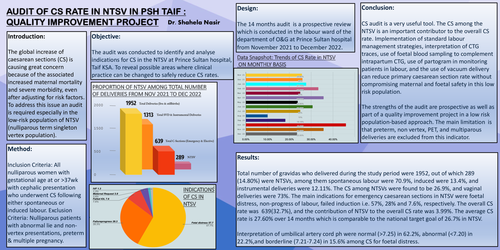
Total number of gravidas who delivered during the study period were 1952, out of which 289 (14.80%) were NTSVs, among them spontaneous labour were 70.9%, induced were 13.4%, and instrumental deliveries were 12.11%. The CS among NTSVs were found to be 26.9%, and vaginal deliveries were 73%. The main indications for emergency caesarean sections in NTSV were foetal distress, non-progress of labour, failed induction i.e. 57%, 28% and 7.6%, respectively. The overall CS rate was 639(32.7%), and the contribution of NTSV to the overall CS rate was 3.99%. The average CS rate is 27.60% over 14 months which is comparable to the national target goal of 26.7% in NTSV.
Interpretation of umbilical artery cord ph were normal (>7.25) in 62.2%, abnormal (<7.20) in 22.2%,and borderline (7.21-7.24) in 15.6% among CS for foetal distress.
Conclusion:
CS audit is a very useful tool. The CS among the NTSV is an important contributor to the overall CS rate. Implementation of standard labour management strategies, interpretation of CTG traces, use of foetal blood sampling to complement intrapartum CTG, use of partogram in monitoring patients in labour, and the use of vacuum delivery can reduce primary caesarean section rate without compromising maternal and foetal safety in this low risk population.
The strengths of the audit are prospective as well as part of a quality improvement project in a low risk population-based approach. The main limitation is that preterm, non vertex, PET, and multiparous deliveries are excluded from this indicator.