1,830 posters, 67 videos, 75 audios, 29 topics, 22 sessions, 4,727 authors, 1,697 institutions
ePostersLive by SciGen Technologies S.A. All rights reserved.
RCOG World Congress 2023
June 12 - 14, 2023 | London, UK

EP.0587
Outcomes of Outpatient and Home Blood Pressure Monitoring in High-Risk Antenatal Women
Poster Presenter
Part of Topic
Quality Improvement
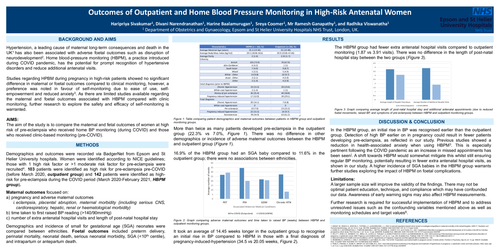
Outcomes of Outpatient and Home Blood Pressure Monitoring in High-Risk Antenatal Women Haripriya Sivakumar1, Divani Narendranathan1, Harine Baalamurugan1, Sreya Coomer1 , Mr Ramesh Ganapathy1, and Radhika Viswanatha1 1 Department of Obstetrics and Gynaecology, Epsom and St Helier University Hospitals NHS Trust, London, UK. BACKGROUND AND AIMS METHODS RESULTS DISCUSSION & CONCLUSION REFERENCES Demographics and outcomes were recorded via BadgerNet from Epsom and St Helier University hospitals. Women were identified according to NICE guidelines; those with 1 high risk factor or >1 moderate risk factor for pre-eclampsia were recruited4. 103 patients were identified as high risk for pre-eclampsia pre-COVID (before March 2020, outpatient group) and 142 patients were identified as highrisk for pre-eclampsia during the COVID period (March 2020-February 2021, HBPM group). Maternal outcomes focused on: a) pregnancy and adverse maternal outcomes i. eclampsia, placental abruption, maternal morbidity (including serious CNS, cardiorespiratory, hepatic, renal or haematological morbidity) b) time taken to first raised BP reading (>140/90mmHg) c) number of extra antenatal hospital visits and length of post-natal hospital stay Demographics and incidence of small for gestational age (SGA) neonates were compared between ethnicities. Foetal outcomes included preterm delivery, perinatal mortality, neonatal death, serious neonatal morbidity, SGA (<10th centile), and intrapartum or antepartum death. In the HBPM group, an initial rise in BP was recognised earlier than the outpatient group. Detection of high BP earlier on in pregnancy could result in fewer patients developing pre-eclampsia, as reflected in our study. Previous studies showed a reduction in health-associated anxiety when using HBPM3. This is especially pertinent following the COVID pandemic as an increase in missed appointments has been seen] . A shift towards HBPM would somewhat mitigate this whilst still ensuring regular BP monitoring, potentially resulting in fewer extra antenatal hospital visits, as shown in our study. A higher incidence of SGA babies in the HBPM group warrants further studies exploring the impact of HBPM on foetal complications. Limitations: A larger sample size will improve the validity of the findings. There may not be optimal patient education, technique, and compliance which may have confounded our data. Awareness of early warning signs may also affect HBPM measurements. Further research is required for successful implementation of HBPM and to address unresolved issues such as the confounding variables mentioned above as well as monitoring schedules and target values6. Figure 1: Table comparing patient demographics and maternal outcomes between patients in HBPM group and outpatient monitoring groups. More than twice as many patients developed pre-eclampsia in the outpatient group (22.3% vs 7.0%, Figure 1). There was no difference in other demographics or incidence of adverse maternal outcomes between the HBPM and outpatient group (Figure 1). 16.9% of the HBPM group had an SGA baby compared to 11.6% in the outpatient group; there were no associations between ethnicities. Figure 2: Graph comparing adverse maternal outcomes and time taken to raised BP (weeks) between HBPM and outpatient monitoring groups. It took an average of 14.45 weeks longer in the outpatient group to recognise an initial rise in BP compared to HBPM in those with a final diagnosis of pregnancy-induced-hypertension (34.5 vs 20.05 weeks, Figure 2). The HBPM group had fewer extra antenatal hospital visits compared to outpatient monitoring (1.87 vs 3.91 visits). There was no difference in the length of post-natal hospital stay between the two groups (Figure 3). Figure 3: Graph comparing average length of post-natal hospital stay and additional antenatal appointments (due to reduced foetal movements, raised BP, and symptoms of pre-eclampsia) between HBPM and outpatient monitoring groups. Characteristics HBPM (n = 142, %) Outpatient (n=103, %) Average Maternal Age (years) 35.3 (19-50) 33 (19-48) Average Body Mass Index (kg/m2) 29.5 (18.06-50.6) 29.9 (19.85-47.46) Average Parity 2 (1-6) 2.33 (1-7) Ethnicity British 105 (73.9) 70 (67.9) Afro-Caribbean 6 (4.2) 1 (1) South Asian 7 (4.9) 9 (8.7) Mixed 5 (3.5) 5 (4.9) White - Other 14 (9.8) 10 (9.7) Asian - Other 3 (2.1) 4 (3.9) Other 2 (1.4) 4 (3.9) Intial diagnosis (prior to HBPM) Chronic Hypertension 19 (13.3) 20 (19.4) White-coat hypertension 2 (1.4) 1 (1) History of pre-eclampsia 36 (25.4) 40 (38.8) Pregnancy induced hypertension 17 (12.0) 30 (29.1) Final Diagnosis Chronic Hypertension 20 (14.1) 7 (6.8) White-coat hypertension 0 0 Pre-eclampsia 10 (7.0) 23 (22.3) Pregnancy induced hypertension 22 (15.5) 10 (9.7) Normotensive 78 (54.9) 63 (61.2) 0 0.5 1 1.5 2 2.5 3 3.5 4 4.5 Average Length of Hospital Stay (days) Average Number of Additional Hospital Visits Pre-COVID (Outpatient) COVID (HBPM) 0 5 10 15 20 25 30 35 40 PET PIH GDM Chronic HTN Average number of weeks Associated Maternal Medical Conditions Pre-COVID (Outpatient) COVID (HBPM) Hypertension, a leading cause of maternal long-term consequences and death in the UK1 has also been associated with adverse foetal outcomes such as disruption of neurodevelopment2. Home blood-pressure monitoring (HBPM), a practice introduced during COVID pandemic, has the potential for prompt recognition of hypertensive disorders and reduce additional antenatal visits. Studies regarding HPBM during pregnancy in high-risk patients showed no significant difference in maternal or foetal outcomes compared to clinical monitoring, however, a preference was noted in favour of self-monitoring due to ease of use, selfempowerment and reduced anxiety3. As there are limited studies available regarding the maternal and foetal outcomes associated with HBPM compared with clinic monitoring, further research to explore the safety and efficacy of self-monitoring is warranted. AIMS: The aim of the study is to compare the maternal and fetal outcomes of women at high risk of pre-eclampsia who received home BP monitoring (during COVID) and those who received clinic-based monitoring (pre-COVID). 1. KNIGHT, M., BUNCH, K., KENYON, S., TUFFNELL, D. and KURINCZUK, J.J., 2020. A national population‐based cohort study to investigate inequalities in maternal mortality in the United Kingdom, 2009‐17. Paediatric and Perinatal Epidemiology, Jul, vol. 34, no. 4, pp. 392-398. Available from: PubMed. ISSN 0269-5022. DOI 10.1111/ppe.12640. 2. SCIME, N.V., HETHERINGTON, E., TOMFOHR-MADSEN, L., NETTEL-AGUIRRE, A., CHAPUT, K.H. and TOUGH, S.C., 2021. Hypertensive disorders in pregnancy and child development at 36 months in the All Our Families prospective cohort study. PloS One, Dec 1, vol. 16, no. 12, pp. e0260590. Available from: MEDLINE. ISSN 1932-6203. DOI 10.1371/journal.pone.0260590. 3. YEH, P.T., RHEE, D.K., KENNEDY, C.E., ZERA, C.A., LUCIDO, B., TUNÇALP, Ö, GOMEZ PONCE DE LEON, R. and NARASIMHAN, M., 2022. Self-monitoring of blood pressure among women with hypertensive disorders of pregnancy: a systematic review. BMC Pregnancy and Childbirth, May 31, vol. 22, no. 1, pp. 454. Available from: PubMed. ISSN 1471-2393. DOI 10.1186/s12884-022-04751-7. 4. National Institute for Health and Care Excellence. (2019). Hypertension in Pregnancy: Diagnosis and Management [Nice Guideline No. 133]. 5. ARZAMANI, N., SORAYA, S., HADI, F., NOORAEEN, S. and SAEIDI, M., 2022. The COVID-19 pandemic and mental health in pregnant women: A review article. Frontiers in Psychiatry, Sep 20, vol. 13, pp. 949239. Available from: CrossRef. ISSN 1664-0640. DOI 10.3389/fpsyt.2022.949239. 6. TRAN, K., PADWAL, R., KHAN, N., WRIGHT, M. and CHAN, W.S., 2021. Home blood pressure monitoring in the diagnosis and treatment of hypertension in pregnancy: a systematic review and meta-analysis. CMAJ Op