1,830 posters, 67 videos, 75 audios, 29 topics, 22 sessions, 4,727 authors, 1,697 institutions
ePostersLive by SciGen Technologies S.A. All rights reserved.
RCOG World Congress 2023
June 12 - 14, 2023 | London, UK

EP.0511
Case- based peer assisted learning in undergraduate medical curriculum: Medical students’ perspectives
Poster Presenter
Part of Topic
Medical Education
Case- based peer assisted learning in undergraduate medical curriculum: Medical students’ perspectives
Alice Kurien, Vasanthapriya Subramaniyam, Poongothai Shanmugaraja, Ashok Kurien
Newcastle University Medicine Malaysia
Introduction
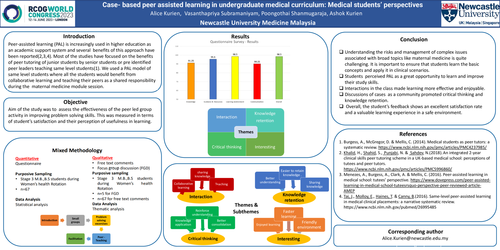
Peer-assisted learning (PAL) is increasingly used in higher education as an academic support system and several benefits of this approach have been reported (2,3,4). Most of the studies have focused on the benefits of peer tutoring of junior students by senior students or pre identified peer leaders teaching same level students (1). We used a PAL model of same level students where all the students would benefit from collaborative learning and teaching their peers as a shared responsibility during the maternal medicine module session.
Objective
Aim of the study was to assess the effectiveness of the peer led group activity in improving problem solving skills. This was measured in terms of student’s satisfaction and their perception of usefulness in learning.
Methodology
Mixed methodology
Quantitative data collection was done through a Validated Questionnaire survey. To satisfy reliability of data, triangulation was done with questionnaire survey, written feedback and focus group discussions. The survey results were analysed under various domains (knowledge acquisition, resources, learning environment, organisation, communication, and the overall experience). Thematic analysis was performed for the written feedback and the focus group discussion.
Results
A total of 67 students participated in the study and our results indicates an overall satisfaction rate of 98.5%. Majority of our students (95.5 %) felt the resources were focussed and relevant. The knowledge acquisition by collaborative discussion and peer assisted learning was rated as 91%. The free text revealed many positive comments and suggestions for future sessions. The results of the qualitative thematic analysis were supported the survey in all aspects. The main themes emerged from the study were Interesting, knowledge retention, interaction, and critical thinking.
Conclusion
Understanding the risks and management of complex issues associated with broad topics like maternal medicine is quite challenging. It is important to ensure that students learn the basic concepts and apply it in clinical scenarios.
Students perceived PAL as a great opportunity to learn maternal medicine and improve their study skills.
Interactions in the class made learning more effective and enjoyable.
Discussions of cases as a community promoted critical thinking and knowledge retention.
Overall, the student’s feedback shows an excellent satisfaction rate and a valuable learning experience in a safe environment.