1,830 posters, 67 videos, 75 audios, 29 topics, 22 sessions, 4,727 authors, 1,697 institutions
ePostersLive by SciGen Technologies S.A. All rights reserved.
RCOG World Congress 2023
June 12 - 14, 2023 | London, UK

EP.0476
Increasing detection and treatment of pre-operative anaemia in patients undergoing gynaecological surgery
Poster Presenter
Authors
Jeannie Jing Yi Yap, Kai Yin Hwang, Soe Na Choo, Claudia Tong, Nurulhuda Ahmad, Bryan Ng, Harvard Lin
Affiliations
Part of Topic
Quality Improvement
Background
Anaemia is defined as haemoglobin level <130g/L in women. Pre-operative anaemia is prevalent in 39% of patients undergoing major non-cardiac surgery. Multiple studies have reported its association with poorer outcomes and increased 30-day morbidity and mortality rate risk.
Iron deficiency is the most common cause of anaemia in gynaecological patients, it not only causes anaemia but may also have a detrimental effect on tissue healing and the body’s adaptation to stress. Iron deficiency anaemia can be easily identified and treated. Screening and treatment of anaemia are essential to optimise patients' condition, reduce unwarranted blood transfusions and improve their outcomes. This is where patient blood management comes into play.
In our local setting, different surgeons may be willing to operate at different haemoglobin thresholds, depending on their experience and the urgency of the surgery. Some patients are given oral iron supplementation, but not all are able to maintain compliance due to the side effects. Intravenous iron is often underused as a treatment for persistent iron deficiency. All this leads to perioperative anaemia which reduces physiological reserve intra-operatively and increases morbidity and mortality.
Our aim is to increase the detection and treatment rate of iron deficiency anaemia in patients undergoing elective major gynaecological surgery.
Methodology
This is a joint quality improvement project and audit conducted by the Department of Obstetrics and Gynaecology and Anaesthesiology at a tertiary centre, National University Hospital (NUH), in Singapore between November 2020 and October 2022.
A baseline audit was conducted in November 2020 to obtain the statistics of the pre-existing detection and treatment rates of anaemia in patients planned for elective major benign gynaecological surgery. We used a locally agreed threshold of Haemoglobin level <110g/L as anaemia in our population.
A pre-operative anaemia treatment workflow was developed and implemented over the next year. Detection of iron deficiency was done via measurement of serum ferritin level. For patients unable to tolerate oral iron supplementation, we have streamlined a workflow to obtain outpatient intravenous iron infusion, hence reducing hospital admissions. Departmental education was also conducted via didactics teaching, including a talk on anaemia by the Haematologist.
The audit cycle was then completed with a re-audit between May and October 2022 to identify the outcomes following the recommendations instituted.
Results
Our baseline audit showed that 21.4% of women had a haemoglobin level <110g/L at the time of listing for surgery (22 out of 103 patients), of which 4.5% were screened for iron deficiency and 72.7% received haematinics. The average intra-operative blood loss was 170ml (5 to 2000ml).
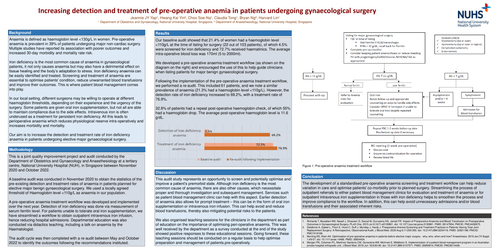
We developed a pre-operative anaemia treatment workflow (as shown on the diagram on the right) and encouraged the use of this to help guide clinicians when listing patients for major benign gynaecological surgery.
Following the implementation of the pre-operative anaemia treatment workflow, we performed a re-audit. This included 61 patients, and we note a similar prevalence of anaemia (21.3% had a haemoglobin level <110g/L). However, the detection rate of iron deficiency increased to 69.2%, with a treatment rate of 76.9%.
32.8% of patients had a repeat post-operative haemoglobin check, of which 55% had a haemoglobin drop. The average post-operative haemoglobin level is 11.6 g/dL.
Discussion
This audit study represents an opportunity to screen and potentially optimise and improve a patient’s premorbid state. Although iron deficiency is the most common cause of anaemia, there are also other causes, which necessitate proper and thorough investigation and subsequent management. Services such as patient blood management clinic can help with this aspect. Earlier detection of anaemia also allows for prompt treatment – this can be in the form of oral iron supplementation or intravenous iron infusion. This can help avoid and reduce blood transfusions, thereby also mitigating potential risks to the patients.
We also organised teaching sessions for the clinicians in the department as part of education on the importance of optimising peri-operative anaemia. This was well received by the department as a survey conducted at the end of the study showed positive responses to these educational sessions. Going forward, these teaching sessions should be conducted on a regular basis to help optimise preparation and management of patients.pre-operatively.
Conclusion
The development of a standardised pre-operative anaemia screening and treatment workflow can help reduce variation in care and optimise patients' co-morbidity prior to planned surgery. Streamlining the process of outpatient referrals to either patient blood management clinics for evaluation and treatment of anaemia or for outpatient intravenous iron supplementation in those with iron deficiency helps to smoothen the process and improve compliance to the workflow. In addition, this can help avoid unnecessary admissions and/or blood transfusions and their associated inherent risks.