1,830 posters, 67 videos, 75 audios, 29 topics, 22 sessions, 4,727 authors, 1,697 institutions
ePostersLive by SciGen Technologies S.A. All rights reserved.
RCOG World Congress 2023
June 12 - 14, 2023 | London, UK

EP.0474
HIGHLIGHTS ON MATERNAL MENTAL HEALTH DISORDERS IN A TERTIARY EMARTI HOSPITAL
Part of Topic
Quality Improvement
HIGHLIGHTS ON MATERNAL MENTAL HEATH DISORDERS IN A TERTIARY EMARTI HOSPITAL
Authors and Affiliations: Dr Shahad Mahmoud Hussein (presenting) 1,2, Dr Afraa Jamal AlYoussef 1, Dr Rubina Rashid Shaikh 1, Dr Fatima Salman 2, Dr Abdul Rahman Taha 2, Dr Tariq Saadaldin Altamimi 2, Dr Walaa Abdul Rahman Alsafi1, Dr Muhieddine Abdul Fatah Seoud 1,2
1 Shaikh Shakhbout Medical City, Abu Dhabi, UAE, 2 Khalifa University, Abu Dhabi, UAE
Objective: To report on a 3-years prevalence of diagnosed perinatal Maternal Mental Health Disorders (MMHD), of women who delivered in a tertiary care center in Abu Dhabi, United Arab Emirates (UAE).
Design: Hospital based retrospective descriptive study
Method: Data were collected from electronic medical records of patients diagnosed with MMHD, who delivered in our hospital,10-01-2020 to 10-01-2023. Study variables were; demographic characteristics, types of MMHD, medications, presence of suicidal ideas/attempts, gestation at presentation, and pregnancy outcomes. Data were entered on an Excel Sheet, and results presented numerically and in percentages.
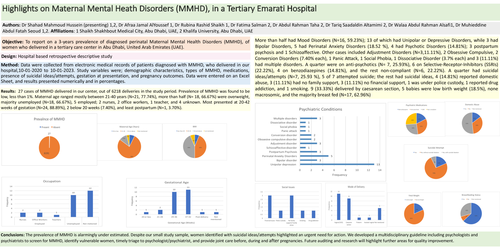
Results: 27 cases of MMHD delivered in our centre, out of 6218 deliveries in the study period. Prevalence of MMHD was found to be low, less than 1%. Maternal age ranged mostly between 21-40 years (N=21, 77.74%), more than half (N= 18, 66.67%) were overweight, majority unemployed (N=18, 66.67%), 5 employed; 2 nurses, 2 office workers, 1 teacher, and 4 unknown. Most presented at 20-42 weeks of gestation (N=24, 88.89%), 2 below 20 weeks (7.40%), and least postpartum (N=1, 3.70%). More than half had Mood Disorders (N=16, 59.23%); 13 of which had Unipolar or Depressive Disorders, while 3 had Bipolar Disorders, 5 had Perinatal Anxiety Disorders (18.52 %), 4 had Psychotic Disorders (14.81%); 3 postpartum psychosis and 1 Schizoaffective. Other cases included Adjustment Disorders (N=3,11.11%), 2 Obsessive Compulsive, 2 Conversion Disorders (7.40% each), 1 Panic Attack, 1 Social Phobia, 1 Dissociative Disorder (3.7% each) and 3 (11.11%) had multiple disorders. A quarter were on anti-psychotics (N= 7, 25.93%), 6 on Selective-Receptor-Inhibitors (SSRIs) (22.22%), 4 on benzodiazepines (14.81%), and the rest non-compliant (N=6, 22.22%). A quarter had suicidal ideas/attempts (N=7, 25.93 %), 5 of 7 attempted suicide; the rest had suicidal ideas, 4 (14.81%) reported domestic abuse, 3 (11.11%) had no family support, 3 (11.11%) no financial support, 1 was under police custody, 1 reported drug addiction, and 1 smoking. 9 (33.33%) delivered by caesarean section, 5 babies were low birth weight (18.5%), none macrosomic, and the majority breast fed (N=17, 62.96%)
Conclusions: The prevalence of MMHD is alarmingly under estimated. Despite our small study sample, women identified with suicidal ideas/attempts highlighted an urgent need for action. We developed a multidisciplinary guideline including psychologists and psychiatrists to screen for MMHD, identify vulnerable women, timely triage to psychologist/psychiatrist, and provide joint care before, during and after pregnancies. Future auditing and research will highlight further areas for quality improvement.