1,830 posters, 67 videos, 75 audios, 29 topics, 22 sessions, 4,727 authors, 1,697 institutions
ePostersLive by SciGen Technologies S.A. All rights reserved.
RCOG World Congress 2023
June 12 - 14, 2023 | London, UK

EP.0452
AUDIT ON LAPAROSCOPIC SURGERY FOR ECTOPIC PREGNANCY
Poster Presenter
Authors
S M R S Bandara, W A B Weerakoon, J G A I H Sandakelum, B K Jayasiri
Affiliations
Part of Topic
Quality Improvement
AUDIT ON LAPAROSCOPIC SURGERY FOR ECTOPIC PREGNANCY IN GYNAECOLOGY AND OBSTETRICS UNIT B TEACHING HOSPITAL ANURADHAPURA
Bandara SMRS, Weerakoon WAB, Sandakelum JGAIH, Jayasiri BK
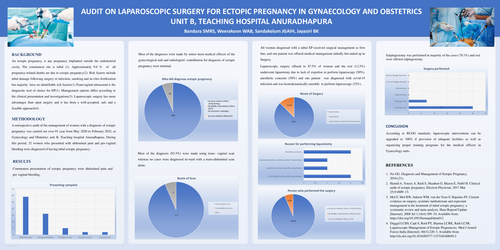
An ectopic pregnancy, is any pregnancy implanted outside the endometrial cavity. The commonest site is tubal (1). Approximately 9.0 % of all pregnancy-related deaths are due to ectopic pregnancy(2). Risk factors include tubal damage following surgery or infection, smoking and in-vitro fertilization but majority have no identifiable risk factors(1).Transvaginal ultrasound is the diagnostic tool of choice for EP(1). Management options differ according to the clinical presentation and investigations(3). Laparoscopic surgery has more advantages than open surgery and it has been a well-accepted, safe and a feasible approach(4). A retrospective audit of the management of women with a diagnosis of ectopic pregnancy was carried out over 01 year from May 2020 to February 2022, at Gynecology and Obstetrics unit B, Teaching hospital Anuradhapura. During this period, 32 women who presented with abdominal pain and per-vaginal bleeding were diagnosed of having tubal ectopic pregnancy. 56.3% cases were diagnosed by the senior most medical officers and 31.3% were diagnosed by the Consultant. Most of the diagnosis (93.5%) were made using trans- vaginal scan whereas no cases were diagnosed in-ward with a trans-abdominal scan alone. Radiologists’ contribution in diagnosing ectopic pregnancy was minimal (3.1%). All women diagnosed with a tubal EP received surgical management as first line, and one patient was offered medical management initially but ended up in Surgery. Laparoscopic surgery offered to 87.5% of women and the rest (12.5%) underwent laparotomy due to lack of expertise to perform laparoscopy (50%), anesthetic concerns (50%) and one patient was diagnosed with covid-19 infection and was hemodynamically unstable to perform laparoscopy (25%). Salpingectomy was performed in majority of the cases (78.1%) and rest were offered salpingostomy. According to RCOG standards, laparoscopic interventions can be upgraded to 100% if provision of adequate facilities as well as organizing proper training programs for the medical officers in Gynecology units.
References
1. No GG. Diagnosis and Management of Ectopic Pregnancy. 2016;(21).
2. Hamid A, Yousry A, Radi S, Shaaban O, Mazen E, Nabil H. Clinical audit of ectopic pregnancy. Electron Physician. 2017 Mar 25;9:4009–13.
3. Mol F, Mol BW, Ankum WM, van der Veen F, Hajenius PJ. Current evidence on surgery, systemic methotrexate and expectant management in the treatment of tubal ectopic pregnancy: a systematic review and meta-analysis. Hum Reprod Update [Internet]. 2008 Jul 1;14(4):309–19. Available from: https://doi.org/10.1093/humupd/dmn012
4. Duggal LCBS, Capt S, Retd PT, Sharma LCRK, Rath LCSK. Laparoscopic Management of Ectopic Pregnancies. Med J Armed Forces India [Internet]. 60(3):220–3. Available from: http://dx.doi.org/10.1016/S0377-1237(04)80049-2