1,830 posters, 67 videos, 75 audios, 29 topics, 22 sessions, 4,727 authors, 1,697 institutions
ePostersLive by SciGen Technologies S.A. All rights reserved.
RCOG World Congress 2023
June 12 - 14, 2023 | London, UK

EP.0441
Impalpable or incorrect position or? broken Nexplanon removal service provision local audit.
Poster Presenter
Authors
Affiliations
Part of Topic
Sexual Health and Contraception
Abstract Title
Impalpable or incorrect position or? broken Nexplanon removal service provision local audit.
Importance of patients’ safety based on national level service standards for impalpable or difficult to palpate or incorrect position or? broken Nexplanon removal service provision in South London, specialist service in the UK.
Objective:
- To provide baseline data for impalpable or difficult to palpate or incorrect position or? broken Nexplanon removal service in CASH (Contraceptive and Sexual Health), OXLEAS NHS Foundation Trust, UK.
- As a benchmark service provision for specialist level three SRH (Sexual & Reproductive Healthcare) service at national level, UK.
Method:
59 cases from 29/03/2021 to 28/03/2022.
6 Auditable standards
Healthcare practitioners undertaking deep or impalpable implant removal procedures have been appropriately trained and have up-to-date national level CPD.
Impalpable or difficult to palpate implant should be localised in the arm by a practitioner trained and experienced in ultrasound using a high-frequency linear array transducer (10 MHz or greater).
Impalpable or difficult to palpate implant should only be attempted after it has been localised in the arm, and then only by a practitioner trained and experienced in complex implant removal techniques, usually with ultrasound guidance.
Impalpable or difficult to palpate implant removal service should have an agreed local pathway for onward referral.
Impalpable or difficult to palpate implant removing service should have a yearly audit and share learning points to improve service provision.
Feedback to inserters who insert impalpable or difficult to palpate implant through their service lead if detectable and advise to seek support through agreed local clinical governance pathways.
Results:
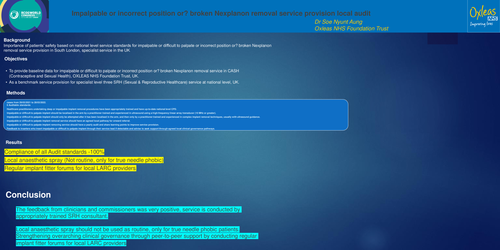
Compliance of all Audit standards -100%
Local anaesthetic spray (Not routine, only for true needle phobic)
Regular implant fitter forums for local LARC providers.
Conclusions:
The feedback from clinicians and commissioners was very positive, service is conducted by appropriately trained SRH consultant.
Local anaesthetic spray should not be used as routine, only for true needle phobic patients.
Strengthening overarching clinical governance through peer-to-peer support by conducting regular implant fitter forums for local LARC providers.