1,830 posters, 67 videos, 75 audios, 29 topics, 22 sessions, 4,727 authors, 1,697 institutions
ePostersLive by SciGen Technologies S.A. All rights reserved.
RCOG World Congress 2023
June 12 - 14, 2023 | London, UK

EP.0440
A Closed Loop Audit of Prophylactic Antibiotics Following Operative Vaginal Deliveries
Poster Presenter
Authors
Affiliations
Part of Topic
Quality Improvement
Reducing Infections Following Operative Vaginal Deliveries
A Closed Loop Audit of Prophylactic Antibiotics Following Operative Vaginal Deliveries
Objective
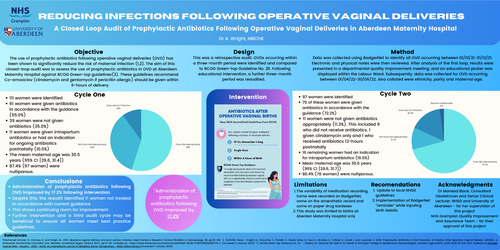
The use of prophylactic antibiotics following operative vaginal deliveries(OVD) has been shown to significantly reduce the risk of maternal infection. The aim of this closed-loop audit was to assess the use of prophylacticantibioticsin OVD at Aberdeen Maternity Hospital against RCOG Green-top guidelines(1). These guidelines recommend Co-amoxiclav(clindamycin and gentamycin if penicillin allergic) should be given within 6-hours of delivery.
Design
This was a retrospectiveaudit. OVDs occurring within a three-month period were identified and compared to RCOG Green-top Guideline No.26. Following educational intervention, a further three-month period was reaudited.
Method
Data was collected using BadgerNetto identify all OVD occurring between 01/10/21-31/12/21.Electronic and physical notes were then reviewed.After analysis of the first loop,results werepresented in a departmental quality improvement meeting, andan educational poster was displayed within the Labour Ward. Subsequently, data was collected for OVD occurring between 01/04/22-30/06/22.Also collated were ethnicity, parity and maternal age.
Results
In the initial audit,111 womenwere identified. Of these, 61 women were given antibiotics in accordance with the guidance (55.0%). 39 women were not given antibiotics (35.0%). The remaining 11 women were given intrapartum antibiotics or had an indication for ongoing antibiotics postnatally (10.0%). The mean maternal age was 30.5 years (95% CI [29.6, 31.4])and 87.4% (97 women) werenulliparous.
Following intervention,the reauditidentified97 women.70 of these women were given antibiotics in accordance with the guidance (72.2%) and11 women were not given antibiotics appropriately (11.3%).This included 9 women who did not receive antibiotics, 1 woman given clindamycin only and 1 woman who received antibiotics 12-hours postnatally. The 16 remaining women had an indication for intrapartum antibiotics (16.5%). In this reaudit, the mean maternal age was 30.6 years (95% CI [29.6, 31.7]) and 80.4% (78 women) were nulliparous.
Conclusions
Administration of prophylactic antibiotics following OVD improved by 17.2% following intervention. Despite this, the reaudit identified11 womennot treated in accordance with current guidance. This shows continuing room for improvement. Further intervention and a third audit cycle may be beneficial to ensure all women meet bestpractice guidelines.