1,830 posters, 67 videos, 75 audios, 29 topics, 22 sessions, 4,727 authors, 1,697 institutions
ePostersLive by SciGen Technologies S.A. All rights reserved.
RCOG World Congress 2023
June 12 - 14, 2023 | London, UK

EP.0439
Multiprofessional obstetric training for medical and midwifery students.
Poster Presenter
Authors
Amy Tomsett, Cathy Winter, Lucy Allanby, Charley Heffer, Jemma Walker, Cressida Bond, Sian Harrington, Melanie Griffin
Affiliations
University of Bristol, Gloucestershire Royal Hospitals NHS Trust, PROMPT Maternity Foundation, Royal United Hospitals NHS Trust, University Hospitals Bristol NHS Trust, University of the West of England, North Bristol NHS Trust
Part of Topic
Medical Education
Audio
Multi-professional obstetric training for medical and midwifery students.
Dr Amy Tomsett1 Ms Cathy Winter2 Dr Lucy Allanby1 Dr Charley Heffer1 Ms Jemma Walker3 Ms Sian Harrington3 Dr Cressida Bond4 Dr Melanie Griffin5
Objective
Our aim was to introduce multi-professional obstetric simulation training to improve understanding, teamwork, communication and clinical skills for medical and midwifery students.
Design
A multi-professional maternity training day was adapted from Practical Obstetric Multi-Professional Training (PROMPT) including structured sessions and simulations on sepsis, postpartum haemorrhage, cord prolapse, shoulder dystocia and maternal collapse.
The day was integrated into the 4th year medical curriculum at University of Bristol and the 2nd and 3rd year midwifery curriculum at the University of the West of England.
Methods
We used a Likert scale to assess improvements in understanding, clinical skills, communication and teamwork.
Data was collected anonymously over 4 training days on paper feedback forms.
Results
243 completed forms were collected (79 midwifery and 154 medical students).
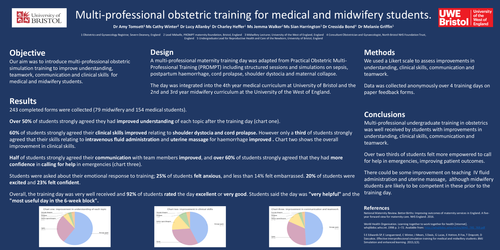
Over 50% of students strongly agreed they had improved understanding of each topic after the training day (chart one).
60% of students strongly agreed their clinical skills improved relating to shoulder dystocia and cord prolapse. However only a third of students strongly agreed that their skills relating to intravenous fluid administration and uterine massage for haemorrhage improved . Chart two shows the overall improvement in clinical skills.
Half of students strongly agreed their communication with team members improved, and over 60% of students strongly agreed that they had more confidence in calling for help in emergencies (chart three).
Students were asked about their emotional response to training; 25% of students felt anxious, and less than 14% felt embarrassed. 20% of students were excited and 23% felt confident.
Overall, the training day was very well received and 92% of students rated the day excellent or very good. Students said the day was "very helpful" and the "most useful day in the 6-week block".
Conclusions
Multi-professional undergraduate training in obstetrics was well received by students with improvements in understanding, clinical skills, communication and teamwork.
Over two thirds of students felt more empowered to call for help in emergencies, improving patient outcomes.
There could be some improvement on teaching IV fluid administration and uterine massage, although midwifery students are likely to be competent in these prior to the training day.