1,830 posters, 67 videos, 75 audios, 29 topics, 22 sessions, 4,727 authors, 1,697 institutions
ePostersLive by SciGen Technologies S.A. All rights reserved.
RCOG World Congress 2023
June 12 - 14, 2023 | London, UK

EP.0291
Cervical screening among the non-responders at Walkden Medical Centre, Manchester
Poster Presenter
Authors
Affiliations
Part of Topic
Quality Improvement
Video
Cervical screening among the non-responders at Walkden Medical Centre, Manchester
Objective: All women aged 25 to 64 in the UK are offered to participate the NHS cervical screening programme every 3 to 5 years depending on their age and where they live. When the individuals do not respond to the invitation externally by the call and recall service under the NHS Cervical Screening Programme, they are classified as ‘non-responders’. Following that, they will usually receive a reminder letter or short message service (SMS) from the GP practice within 2 weeks. This study aims to evaluate how well the protocol is being followed and review different ways to improve cervical screening uptake.
Design: This is a retrospective analysis of 168 non-responders for cervical screening at Walkden Medical Centre in Manchester over two years.
Method: The patients’ electronic records on EMIS were extracted from 25th April 2020 to 25th April 2022 using the code system ‘cervical smear non-responders’ and recorded on Microsoft Excel. The study has included all non-responders for cervical screening.
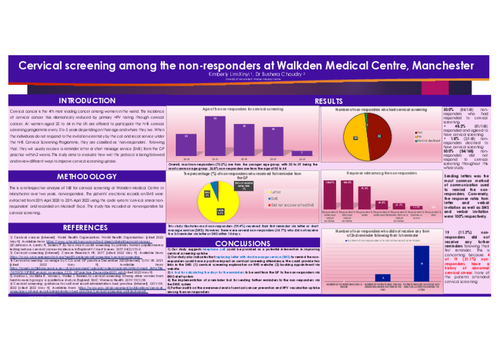
Results: Overall, most non-responders (73.2%) are from the younger age group, with 30 to 39 being the most common age group. This study illustrates most non-responders (99.4%) received their first reminder via letter or short message service (SMS). However, there were several non-responders (34.7%) who did not receive the 1st reminder via letter or SMS within 14 days.
On the other hand, 19 non-responders did not receive any further reminders following their first reminder. This is concerning because 4 of 19 (21.1%) non-responders have a history of abnormal cervical smear. Nevertheless, the data established half of the non-responders (50.0%) responded to cervical screening in this study. Sending letters was the most common method of communication used to remind the non-responders. Conversely, the response rates from letter and verbal invitation as well as SMS and verbal invitation were 100% respectively.
Conclusions
Our study suggests replacing letter with telephone calls or short message service (SMS) could have a positive impact on cervical screening attendance. This study also revealed a tool for calculating the days for the reminders to be sent from the GP practice to the non-responders via EMIS alert system could be effective to ensure that all non-responders are contacted by the practice. Further audits on the awareness level of cervical cancer prevention among the non-responders should be considered to warrant more recommendations for improving cervical screening uptake.