1,830 posters, 67 videos, 75 audios, 29 topics, 22 sessions, 4,727 authors, 1,697 institutions
ePostersLive by SciGen Technologies S.A. All rights reserved.
RCOG World Congress 2023
June 12 - 14, 2023 | London, UK

EP.0215
Birth Companion-integrated Birth Preparedness and Complication Readiness Package for Improving Childbirth Experience
Poster Presenter
Part of Topic
Medical Education
Birth Companion-integrated Birth Preparedness and Complication Readiness Package for Improving Childbirth Experience
Background:
Birth preparedness and complication readiness (BP and CR) is a universally recognized and endorsed strategy integral to safe motherhood programs, aimed at mitigating care-related delays and facilitating prompt access to skilled maternal and neonatal healthcare, particularly during the childbirth process. This approach is grounded in the underlying principle that proactive preparation for childbirth and the proactive anticipation of potential complications contribute to minimizing delays in accessing essential care services.
Objectives:
Primary Objectives:
Secondary Objective:
Study Design: A facility-based pre-test and post-test quasi-experimental study which used a non-equivalent control group to recruit primigravid women.
Study Population: Primigravida women, who came to Jawaharlal Nehru Medical College and Hospital during data collection period who were eligible for the study were included (35 in each group).
Study Duration: 26th November, 2020 to 25th November, 2022 (24 months)
Study Tools: A structured questionnaire (consisting of 42 items) adapted from JHPIEGO BP monitoring tool, for assessment of BPCR and awareness of danger signs was used.
After the implementation of the BPCR awareness package within the intervention group, a subsequent post-test was conducted to evaluate the extent of their knowledge enhancement.
To assess the childbirth experience of the women involved, a comprehensive questionnaire comprising 22 closed-ended questions was administered. This questionnaire employed a response format utilizing both a 4-point Likert Scale and a Visual Analogue Scale (VAS). Comparative analysis was performed by contrasting the results obtained from the intervention group with those from a control group that did not receive the BPCR awareness package.
Results:
The pre-test showed that the study group was better prepared than the control group in terms of identifying a skilled birth attendant and identifying a place of delivery (p-value < 0.001).
Post-test score showed significant improvement in knowledge of the participants (p-value < 0.05).
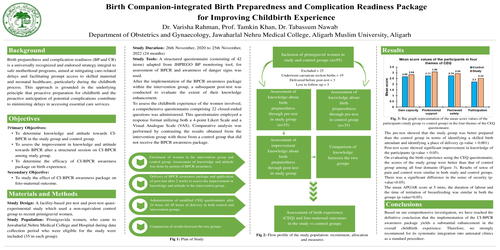
On evaluating the birth experience using the CEQ questionnaire, the scores of the study group were better than that of control group among all four domains (Figure 3). Results of sense of pain and control were similar in both study and control groups. There was a significant difference in the sense of security (p-value<0.05).
The mean APGAR score at 5 mins, the duration of labour and the time of initiation of breastfeeding was similar in both the groups (p-value>0.05).
Conclusion:
Based on our comprehensive investigation, we have reached the definitive conclusion that the implementation of the CI-BPCR awareness package yields a substantial enhancement in the overall childbirth experience. Therefore, we strongly recommend for its systematic integration into antenatal clinics as a standard procedure.