1,830 posters, 67 videos, 75 audios, 29 topics, 22 sessions, 4,727 authors, 1,697 institutions
ePostersLive by SciGen Technologies S.A. All rights reserved.
RCOG World Congress 2023
June 12 - 14, 2023 | London, UK

EP.0193
Time to Reset the NHS Maternity Digital Dataset
Poster Presenter
Part of Topic
Quality Improvement
Video
Time to Reset the Maternity Digital Dataset
By Amber Dhoot¹, Laura Denley², Stelios Myriknas² and Sunita Sharma²
Affiliations: ¹ = Imperial College London, ² = Chelsea and Westminster Hospital NHS Foundation Trust
Background and Objective:
In England, recent reviews of NHS maternity services1-2 have highlighted learnings and recommendations to improve safety within the service. Themes identified included listening to patients, families, and staff; patterns of repeated poor care; failure in team working, governance and leadership; and lack of learning from safety incidents. Also highlighted is the traditional encouragement to promote normal birth and maintain the caesarean birth (CB) rate around 20%. However, in 2022, NHS England and NHS Improvement stated that hospitals should not use “total caesarean section rates as means of performance management” as these targets “may be clinically inappropriate or unsafe in individual cases”.
Our objective was to study the birth trend in Chelsea and Westminster Hospital Maternity Department and assess what digital datasets are available to inform front-line clinicians’ service improvements to respond to the review findings.
Design:
Review of our NHS Trust’s data as captured by the NHS Digital National Maternity Dashboard (NDNMD)3, Perinatal Mortality Review Tool (PMRT)4, Care Quality Commission reports, Healthcare Safety Investigation Bureau (HSIB) and local serious untoward incidents
Methods:
Results:
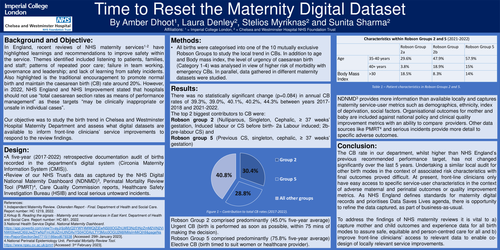
There was no statistically significant change (p=0.084) in annual CB rates of 39.3%, 39.0%, 40.1%, 40.2%, 44.3% between years 2017-2018 and 2021-2022.
The top 2 biggest contributors to CB were:
Robson group 2 (Nulliparous, Singleton, Cephalic, ≥ 37 weeks’ gestation, Induced labour or CS before birth- 2a Labour induced; 2b- pre-labour CS) and
Robson group 5 (Previous CS, singleton, cephalic, ≥ 37 weeks’ gestation)
Robson Group 2 comprised predominantly (45.0% five-year average) Urgent CB (birth is performed as soon as possible, within 75 mins of making the decision).
Robson Group 5 comprised predominantly (75.8% five-year average) Elective CB (birth timed to suit women or healthcare provider).
NDNMD3 provides more information than available locally and captures maternity service-user metrics such as demographics, ethnicity, index of deprivation, social factors. Organisational outcomes for mother and baby are included against national policy and clinical quality improvement metrics with an ability to compare providers. Other data sources like PMRT4 and serious incidents provide more detail to specific adverse outcomes.
Conclusion:
The CB rate in our department, whilst higher than NHS England’s previous recommended performance target, has not changed significantly over the last 5 years. Undertaking a similar local audit for other birth modes in the context of associated risk characteristics with final outcomes proved difficult. At present, front-line clinicians only have easy access to specific service-user characteristics in the context of adverse maternal and perinatal outcomes or quality improvement metrics. As NHS England defines standards for maternity digital records and prioritises Data Saves Lives agenda, there is opportunity to refine the data captured, as part of business-as-usual.
To address the findings of NHS maternity reviews it is vital to a) capture mother and child outcomes and experience data for all birth modes to assure safe, equitable and person-centred care for all and b) improve front-line clinicians’ access to relevant data to enable co-design of locally relevant service improvements.
References: