1,830 posters, 67 videos, 75 audios, 29 topics, 22 sessions, 4,727 authors, 1,697 institutions
ePostersLive by SciGen Technologies S.A. All rights reserved.
RCOG World Congress 2023
June 12 - 14, 2023 | London, UK

PP.0190
Implementing the quality improvement project Birmingham Symptom-specific Obstetric Triage System locally
Poster Presenter
Authors
Affiliations
Part of Topic
Quality Improvement
Implementing the quality improvement project Birmingham Symptom-specific Obstetric Triage System (BSOTS) at
The Princess Alexandra Hospital NHS Trust, Harlow, United Kingdom
B Z Saeed ST7 Obstetrics and Gynaecology, Miss M Deshpande Consultant Obstetrician and Lead for Obstetrics
The Princess AlexandraHospital NHS Trust, Harlow, United Kingdom
Introduction:
The maternity triage departments are the emergency portals for women to access maternity services with unexpected complications or concerns. The maternity triage departments have been established to see women away from delivery suites. As part of this assessment, women undergo clinical triage, ideally within 15 minutes of arrival, to determine the priority of their care and treatment based on the severity of their presenting complaint. The different patient safety issues within maternity triage departments have been identified through different safety implanting tools and confidential enquiries.
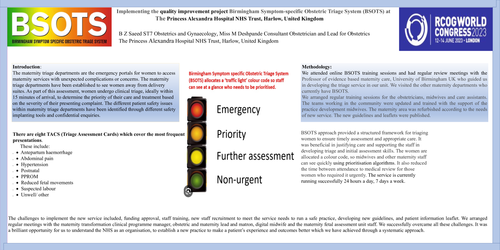
There are eight TACS (Triage Assessment Cards) which cover the most frequent presentations.
These include:
Methodology:
We attended online BSOTS training sessions and had regular review meetings with the Professor of evidence based maternity care, University of Birmingham UK who guided us in developing the triage service in our unit. We visited the other maternity departments who currently have BSOTS.
We arranged regular training sessions for the obstetricians, midwives and care assistants. The teams working in the community were updated and trained with the support of the practice development midwives. The maternity area was refurbished according to the needs of new service. The new guidelines and leaflets were published.
BSOTS approach provided a structured framework for triaging women to ensure timely assessment and appropriate care. It was beneficial in justifying care and supporting the staff in developing triage and initial assessment skills. The women are allocated a colour code, so midwives and other maternity staff can see quickly using prioritisation algorithms. It also reduced the time between attendance to medical review for those women who required it urgently. The service is currently running successfully 24 hours a day, 7 days a week.
The challenges to implement the new service included, funding approval, staff training, new staff recruitment to meet the service needs to run a safe practice, developing new guidelines, and patient information leaflet. We arranged regular meetings with the maternity transformation clinical programme manager, obstetric and maternity lead and matron, digital midwife and the maternity fetal assessment unit staff. We successfully overcame all these challenges. It was a brilliant opportunity for us to understand the NHS as an organisation, to establish a new practice to make a patient’s experience and outcomes better which we have achieved through a systematic approach.