1,830 posters, 67 videos, 75 audios, 29 topics, 22 sessions, 4,727 authors, 1,697 institutions
ePostersLive by SciGen Technologies S.A. All rights reserved.
RCOG World Congress 2023
June 12 - 14, 2023 | London, UK

PP.0186
Evaluating manual dexterity with a robotic surgical simulator during Gynaecology residency interviews
Poster Presenter
Part of Topic
Medical Education
Video
Evaluating manual dexterity during Obstetrics and Gynaecology residency interviews –
The use of a robotic surgical simulator
Grace MF Chan1, Kelvin ZX Lee1, Karen MX Lim1, Susan JS Logan1
1 Department of Obstetrics and Gynaecology, National University Hospital, 1E Kent Ridge Road, Singapore 119228, Singapore
Introduction:
Residency interviews aim to select candidates that have qualities for success in the long term. In a surgical speciality such as Obstetrics and Gynaecology (O&G), manual dexterity, spatial awareness and hand-eye coordination are essential skills1. Robotic surgery is playing an increasingly important role in benign and cancer gynaecology2, and the da Vinci (Intuitive Surgical Inc.) robotic simulator has been shown to be a training tool with predictive validity3. Currently, there are no validated objective measures for the assessment of spatial or manual skills at residency interviews4.
Objective: We aim to evaluate the effectiveness of a robotic surgical simulator for assessing manual dexterity aptitude at O&G residency interviews.
Methods
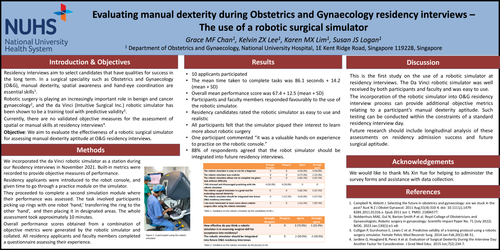
We incorporated the da Vinci robotic simulator as a station during our Residency interviews in November 2021. Built-in metrics were recorded to provide objective measures of performance. Residency applicants were introduced to the robot console, and given time to go through a practice module on the simulator. They proceeded to complete a second simulation module where their performance was assessed. The task involved participants picking up rings with one robot ‘hand,’ transferring the ring to the other ‘hand’, and then placing it in designated areas. The whole assessment took approximately 10 minutes. Overall performance scores obtained from a combination of objective metrics were generated by the robotic simulator and collated. All residency applicants and faculty members completed a questionnaire assessing their experience.
Results:
This is the first study on the use of a robotic simulator at residency interviews. The Da Vinci robotic simulator was well received by both participants and faculty and was easy to use. The incorporation of the robotic simulator into O&G residency interview process can provide additional objective metrics relating to a participant’s manual dexterity aptitude. Such testing can be conducted within the constraints of a standard residency interview day. Future research should include longitudinal analysis of these assessments on residency admission success and future surgical aptitude.