1,830 posters, 67 videos, 75 audios, 29 topics, 22 sessions, 4,727 authors, 1,697 institutions
ePostersLive by SciGen Technologies S.A. All rights reserved.
RCOG World Congress 2023
June 12 - 14, 2023 | London, UK

EP.0183
Implementation of the London Measure of Unplanned Pregnancy into antenatal care.
Poster Presenter
Authors
Catherine Stewart, Bryony Stoneman, Tamsin Bicknell, Geraldine Barrett, Jennifer Hall
Affiliations
Part of Topic
Quality Improvement
Implementation of the London Measure of Unplanned Pregnancy into antenatal care
Catherine Stewart (1), Bryony Stoneman (2), Tamsin Bicknell (3) Dr Geraldine Barrett (1), Dr Jennifer Hall (1).
(1) Sexual and Reproductive Health Research Team, UCL EGA Institute of Women’s Health.
(2) Research Midwife, Maternity Services, EGA Wing, UCLH.
(3) Consultant Midwife, Homerton Healthcare
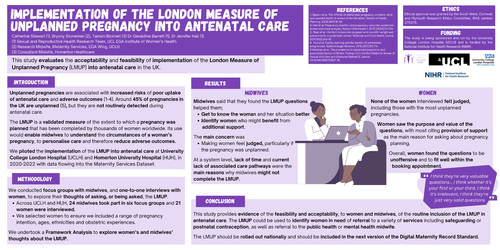
This study evaluates the acceptability and feasibility of implementation of the London Measure of Unplanned Pregnancy (LMUP) into antenatal care in the UK.
Introduction
Unplanned pregnancies are associated with increased risks of poor uptake of antenatal care and adverse outcomes (1-4). Around 45% of pregnancies in the UK are unplanned (5), but they are not routinely detected during antenatal care.
The LMUP is a validated measure of the extent to which a pregnancy was planned that has been completed by thousands of women worldwide. Its use would enable midwives to understand the circumstances of a woman’s pregnancy, to personalise care and therefore reduce adverse outcomes.
We piloted the implementation of the LMUP into antenatal care at University College London Hospital (UCLH) and Homerton University Hospital (HUH), in 2020-2022 with data flowing into the Maternity Services Dataset.
Methodology
We conducted focus groups with midwives, and one-to-one interviews with women, to explore their thoughts of asking, or being asked, the LMUP.
Across UCLH and HUH, 24 midwives took part in six focus groups and 21 women were interviewed.
We selected women to ensure we included a range of pregnancy intention, ages, ethnicities and obstetric experiences.
We undertook a Framework Analysis to explore women’s and midwives’ thoughts about the LMUP.
Results
Midwives said that they found the LMUP questions helped them;
- Get to know the woman and her situation better
- Identify women who might benefit from additional support.
The main concern was
- Making women feel judged, particularly if the pregnancy was unplanned.
At a system level, lack of time and current lack of associated care pathways were the main reasons why midwives might not complete the LMUP.
None of the women interviewed felt judged, including those with the most unplanned pregnancies.
Women saw the purpose and value of the questions, with most citing provision of support as the main reason for asking about pregnancy planning.
Overall, women found the questions to be unoffensive and to fit well within the booking appointment.
“I think they're very valuable questions… I think whether it's your first or your third, I think it's irrelevant, I think they're just very solid questions”
Conclusion
This study provides evidence of the feasibility and acceptability, to women and midwives, of the routine inclusion of the LMUP in antenatal care. The LMUP could be used to identify women in need of referral to a variety of services including safeguarding or postnatal contraception, as well as referral to the public health or mental health midwife.
The LMUP should be rolled out nationally and should be included in the next version of the Digital Maternity Record Standard.
Ethics
Ethical approval was granted by the South West, Cornwall and Plymouth Research Ethics Committee, IRAS number 270375.
Funding
The study is being sponsored and run by the University College London Hospital (UCLH) and is funded by the National Institute for Health Research (NIHR).
References
1. Gipson et al. The effects of unintended pregnancy on infant, child, and parental health: A review of the literature. Studies in Family Planning. 2008;39(1):18-38.
2. Hall et al. Pregnancy intention and pregnancy outcome: systematic review and meta-analysis. Matern Child Health J. 2017;21(3):670-704.
3. Shah et al. Intention to become pregnant and low birth weight and preterm birth: a systematic review. Maternal and Child Health Journal. 2011;15(2):205-16.
4. Tsui et al. Family planning and the burden of unintended pregnancies. Epidemiologic Reviews. 2010;32(1):152-74.
5.Wellings et al. The prevalence of unplanned pregnancy and associated factors in Britain: findings from the third National Survey of Sexual Attitudes and Lifestyles (Natsal-3). Lancet. 2013;382(9907):1807-16.