1,830 posters, 67 videos, 75 audios, 29 topics, 22 sessions, 4,727 authors, 1,697 institutions
ePostersLive by SciGen Technologies S.A. All rights reserved.
RCOG World Congress 2023
June 12 - 14, 2023 | London, UK

PP.0148
Harnessing augmented reality technology for medical education –A virtual abdominal hysterectomy
Poster Presenter
Authors
Jonathan Youxiang Han, Xinyi Li, Wileen Lim, Belinda Huang, Manisha Mathur
Affiliations
Part of Topic
Medical Education
Harnessing augmented reality technology for medical education –A virtual abdominal hysterectomy
Objective:
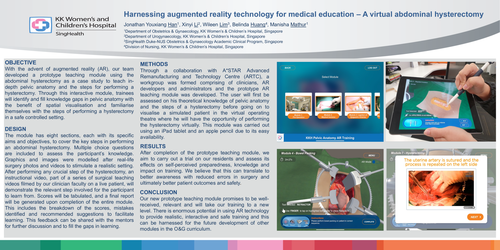
With the advent of augmented reality (AR), our team developed a prototype teaching module using the abdominal hysterectomy as a case study to teach in-depth pelvic anatomy and the steps for performing a hysterectomy. Through this interactive module, trainees will identify and fill knowledge gaps in pelvic anatomy with the benefit of spatial visualisation, and familiarise themselves with the steps of performing a hysterectomy in a safe controlled setting.
Design:
The module has eight sections, each with its specific aims, objectives, to cover the key steps in performing an abdominal hysterectomy. Multiple choice questions are included to assess the participant’s knowledge. Graphics and images were modelled after real-life surgery photos and videos to stimulate a realistic setting. After performing any crucial step of the hysterectomy, an instructional video, part of a series of surgical teaching videos filmed by our clinician faculty on a live patient, will demonstrate the relevant step involved for the participant to learn from. Scores will be tabulated and a final report will be generated upon completion of the entire module. This includes the breakdown of the scores, mistakes identified and recommended suggestions to facilitate learning. This feedback can be shared with the mentors for further discussion and to fill the gaps in learning.
Methods:
Through a collaboration with A*STAR Advanced Remanufacturing and Technology Centre (ARTC), a workgroup was formed comprising of clinicians, AR developers and administrators and the prototype AR teaching module was developed. The user will first be assessed on his theoretical knowledge of pelvic anatomy and the steps of a hysterectomy before going on to visualise a simulated patient in the virtual operating theatre where he will have the opportunity of performing the hysterectomy virtually. This module was carried out using an iPad tablet and an apple pencil due to its easy availability.
Results:
After completion of the prototype teaching module, we aim to carry out a trial on our residents and assess its effects on self-perceived preparedness, knowledge and impact on training. We believe that this can translate to better awareness with reduced errors in surgery and ultimately better patient outcomes and safety.
Conclusion:
Our new prototype teaching module promises to be well-received, relevant and will take our training to a new level. There is enormous potential in using AR technology to provide realistic, interactive and safe training and this can be harnessed for the future development of other modules in the O&G curriculum.