1,830 posters, 67 videos, 75 audios, 29 topics, 22 sessions, 4,727 authors, 1,697 institutions
ePostersLive by SciGen Technologies S.A. All rights reserved.
RCOG World Congress 2023
June 12 - 14, 2023 | London, UK

PP.0146
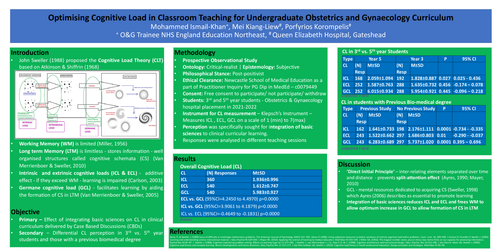
Optimising Cognitive Load in Classroom Teaching for Undergraduate Obstetrics and Gynaecology Curriculum.
Poster Presenter
Part of Topic
Medical Education
Introduction
Objective
Methodology
Prospective Observational Study
Ontology: Critical-realist | Epistemology: Subjective
Philosophical Stance: Post-positivist
Ethical Clearance: Newcastle School of Medical Education as a part of Practitioner Inquiry for PG Dip in MedEd – c0079449
Consent: Free consent to participate/ not participate/ withdraw
Students: 3rd and 5th year students - Obstetrics & Gynaecology hospital placement in 2021-2022
Instrument for CL measurement – Klepsch’s Instrument – Measures ICL , ECL, GCL on a scale of 1 (min) to 7(max)
Perception was specifically sought for integration of basic sciences to clinical curricular learning.
Responses were analysed in different teaching sessions
Results
Overall Cognitive Load (CL)
CL in 3rd vs. 5th year Students
CL in students with Previous Bio-medical degree
Discussion
‘Direct Initial Principle’ – inter-relating elements separated over time and distance - prevents split-attention effect (Ayres, 1990; Mayer, 2010)
GCL - mental resources dedicated to acquiring CS (Sweller, 1998) which Ayres (2006) describes as essential to promote learning
Integration of basic sciences reduces ICL and ECL and frees WM to allow optimum increase in GCL to allow formation of CS in LTM
References
- Ayres, P., & Sweller, J. (1990) Locus of difficulty in multistage mathematics problems. The American Journal of Psychology 103(2) 167–193.
- Ayres P. (2006). Using subjective measures to detect variations of intrinsic cognitive load within problems. Learn. Instr. 16, 389–400.
- Carlson R, Chandler P, Sweller J. (2003). Learning and understanding science instructional material. J Educ Psychol 95 629–640.
- Mayer RE. (2010). Applying the science of learning to medical education. Med Educ 44 543–549.
- Miller GA. (1956). The magical number seven, plus or minus two: Some limits on our capacity for processing information. Psychol Rev 63 81–97.
- Sweller J. (1988). Cognitive load during problem solving: Effects on learning.Cogn Sci 12 257–285.
- Sweller J., van Merrienboer J. J. G., Paas F. G. W. C. (1998). Cognitive architecture and instructional design. Educ. Psychol. Rev 10 251–296.
- Van Merrie¨nboer JJG, Sweller J. (2005). Cognitive load theory and complex learning: Recent developments and future directions. Educ Psychol Rev 17 147–177.
- Van Merrienboer JJG, Sweller J. (2010). Cognitive load theory in health professional education: Design principles and strategies. Med Educ 44 85–93.