1,830 posters, 67 videos, 75 audios, 29 topics, 22 sessions, 4,727 authors, 1,697 institutions
ePostersLive by SciGen Technologies S.A. All rights reserved.
RCOG World Congress 2023
June 12 - 14, 2023 | London, UK

PP.0139
RCOG CORE CURRICULUM AND PREPARATION FOR THE SURGICAL MANAGEMENT OF OOH GYNAECOLOGY
Poster Presenter
Authors
Affiliations
Part of Topic
Medical Education
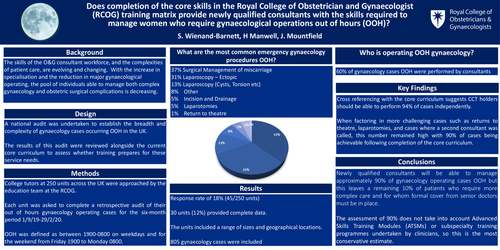
Does completion of the core skills in the Royal College of Obstetrician and Gynaecologist (RCOG) training matrix provide newly qualified consultants with the skills required to manage women who require gynaecological operations out of hours (OOH)?
S. Wienand-Barnett, H Manwell, J. Mountfield
The skills of the O&G consultant workforce, and the complexities of patient care, are evolving and changing. With the increase in specialisation and the reduction in major gynaecological operating, the pool of individuals able to manage both complex gynaecology and obstetric surgical complications is decreasing.
A national audit was undertaken to establish the breadth and complexity of gynaecology cases occurring OOH in the UK. The results of this audit were reviewed alongside the current core curriculum to assess whether training prepares for these service needs.
College tutors at 250 units across the UK were approached by the education team at the RCOG.
Each unit was asked to complete a retrospective audit of their out of hours gynaecology operating cases for the six-month period 1/9/19-29/2/20.
OOH was defined as between 1900-0800 on weekdays and for the weekend from Friday 1900 to Monday 0800.
37% Surgical Management of miscarriage
31% Laparoscopy – Ectopic
13% Laparoscopy (Cysts, Torsion etc)
8% Other
5% Incision and Drainage
5% Laparotomies
1% Return to theatre
Response rate of 18% (45/250 units)
30 units (12%) provided complete data.
The units included a range of sizes and geographical locations.
805 gynaecology cases were included
60% of gynaecology cases OOH were performed by consultants
Cross referencing with the core curriculum suggests CCT holders should be able to perform 94% of cases independently.
When factoring in more challenging cases such as returns to theatre, laparotomies, and cases where a second consultant was called, this number remained high with 90% of cases being achievable following completion of the core curriculum.
Newly qualified consultants will be able to manage approximately 90% of gynaecology operating cases OOH but this leaves a remaining 10% of patients who require more complex care and for whom formal cover from senior doctors must be in place.
The assessment of 90% does not take into account Advanced Skills Training Modules (ATSMs) or subspecialty training programmes undertaken by clinicians, so this is the most conservative estimate.