1,830 posters, 67 videos, 75 audios, 29 topics, 22 sessions, 4,727 authors, 1,697 institutions
ePostersLive by SciGen Technologies S.A. All rights reserved.
RCOG World Congress 2023
June 12 - 14, 2023 | London, UK

PP.0122
Assessing emergency neonatal transfers as a sensitive measure of maternity service risk.
Poster Presenter
Part of Topic
Quality Improvement
Assessing emergency neonatal transfers as a sensitive measure of maternity service risk.
Dr Benjamin M Nowotny1,2,3, Dr Miranda Davies-Tuck2,3, Prof Peter Davis4,5, Dr Michael Stewart5,6, Prof Euan M Wallace2,3,7
1 Monash Health, Melbourne AUS; 2 Monash University, Melbourne AUS; 3 Ritchie Centre, Melbourne AUS; 4 Royal Women’s Hospital, Melbourne AUS; 5 University of Melbourne, Melbourne AUS; 6 Royal Children’s Hospital, Melbourne AUS; 7 Department of Health & Human Services, Melbourne AUS
Objective
(i) To assess the distribution of emergency neonatal emergency transfers in the state of Victoria, Australia; and (ii) to identify whether emergency neonatal transfer data could be used as measures of maternity service patient safety and quality.
Design
Quantitative descriptive study of neonatal transfers within the state of Victoria, Australia for the 14 year period 1 January 2002 to 31 December 2016. This period was chosen to align with a source data system change & to allow sufficient time for subsequent safety failures to be detected.
Methods
Neonatal transfer data from the state emergency transfer service was collated for all 46 maternity services with a capability of level 2 or higher. Denominator birth counts were obtained from Victorian Perinatal Data Collection. Case summaries were exported for all transfers. Cases were excluded if they were non-emergent transfers (e.g. returning) or not directly relating to newborn births. Cases were coded using a purpose designed coding scheme assigning transfer issue to one of 17 categories using a framework previously validated for coding patient complaints. Indication categories were: respiratory condition; gastrointestinal condition; cardiac condition; prematurity; infection; fetal compromise; neurological condition; congenital abnormality; hypoglycaemia; haematological condition; jaundice; renal or genitourinary condition; birth trauma; cardiopulmonary arrest; intrauterine growth restriction; and other.
Results
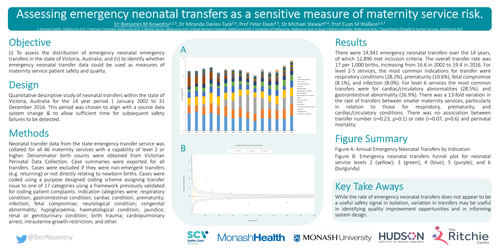
There were 14,941 emergency neonatal transfers over the 14 years, of which 12,890 met inclusion criteria. The overall transfer rate was 17 per 1,000 births, increasing from 16.6 in 2002 to 19.4 in 2016. For level 2-5 services, the most common indications for transfer were respiratory conditions (28.2%), prematurity (10.6%), fetal compromise (8.1%), and infection (8.0%). For level 6 services the most common transfers were for cardiac/circulatory abnormalities (28.5%), and gastrointestinal abnormality (26.9%). There was a 13-fold variation in the rate of transfers between smaller maternity services, particularly in relation to those for respiratory, prematurity, and cardiac/circulatory conditions. There was no association between transfer number (r=0.23, p=0.1) or rate (r=0.07, p=0.6) and perinatal mortality.
Key Take Aways
While the rate of emergency neonatal transfers does not appear to be a useful safety signal in isolation, variation in transfers may be useful in identifying quality improvement opportunities and in informing system design.