1,830 posters, 67 videos, 75 audios, 29 topics, 22 sessions, 4,727 authors, 1,697 institutions
ePostersLive by SciGen Technologies S.A. All rights reserved.
RCOG World Congress 2023
June 12 - 14, 2023 | London, UK

PP.0117
How do regulatory maternity ratings compare with outcomes from national routinely-collected data?
Poster Presenter
Part of Topic
Quality Improvement
How do regulatory maternity ratings compare with outcomes from national routinely-collected data?
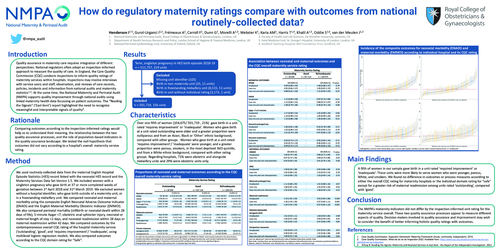
Quality assurance in maternity care requires integration of different perspectives. National regulators often adopt an inspection-informed approach to measure the quality of care. In England, the Care Quality Commission (CQC) conducts inspections to inform quality ratings of maternity services within hospitals. Inspections may involve interviews with service users and staff, observation, and reviews of care records, policies, incidents and information from national audits and maternity statistics1-2. At the same time, the National Maternity and Perinatal Audit (NMPA) supports quality improvement through national audits using linked maternity health data focussing on patient outcomes. The “Reading the Signals” (‘East Kent’) report highlighted the need to recognise meaningful and interpretable signals of quality3.
Comparing outcomes according to the inspection-informed ratings would help us to understand their meaning, the relationship between the two quality assurance processes, and the role of population-based indicators in the quality assurance landscape. We tested the null hypothesis that outcomes did not vary according to a hospital’s overall maternity service rating.
We used routinely-collected data from the maternal English Hospital Episode Statistics (HES) record linked with the neonatal HES record and the Maternity Services Data Set Version 1.5. We included women with a singleton pregnancy who gave birth at 37 or more completed weeks of gestation between 1st April 2018 and 31st March 2019. We excluded women without a hospital identifier, who gave birth outside of a maternity unit, or in a freestanding midwifery unit. We compared neonatal and maternal morbidity using the composite English Neonatal Adverse Outcome Indicator (ENAOI) and the English Maternal Morbidity Obstetric Indicator (EMMOI). We also compared perinatal mortality (stillbirth or neonatal death within 28 days of life), 5-minute Apgar <7, obstetric anal sphincter injury, neonatal or maternal length of stay >2 days, and neonatal readmission within 28 days or maternal readmission within 42 days. We compared outcomes by the contemporaneous overall CQC rating of the hospital maternity service (‘outstanding’, ‘good’, and ‘requires improvement’/ ‘inadequate’, using multilevel logistic regression models. We also compared outcomes according to the CQC domain rating for “Safe”.