1,830 posters, 67 videos, 75 audios, 29 topics, 22 sessions, 4,727 authors, 1,697 institutions
ePostersLive by SciGen Technologies S.A. All rights reserved.
RCOG World Congress 2023
June 12 - 14, 2023 | London, UK

PP.0111
Laparoscopic suture techniques for cuff closure: a randomized controlled study
Poster Presenter
Authors
Iliana Calabretti, Laura Gubser, Christiane Förster, Andreas Schötzau, Bernhard Fellmann-Fischer, Viola Heinzelmann-Schwarz, Tibor Zwimpfer
Affiliations
Medical Faculty, University of Basel, Department of Obstetrics and Gynaecology, University Hospital Basel, Department of Gynaecological Oncology, University Hospital Basel
Part of Topic
Medical Education
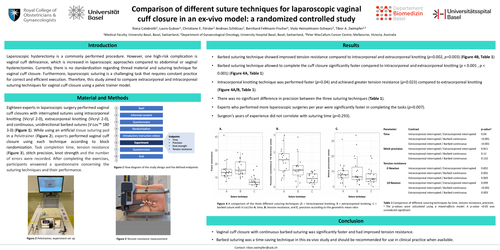
Comparison of different suture techniques for laparoscopic vaginal cuff closure in an ex-vivo model: a randomized controlled study
Introduction
Laparoscopic hysterectomy is a commonly performed procedure. However, one high-risk complication is vaginal cuff dehiscence, which is increased in laparoscopic approaches compared to abdominal or vaginal hysterectomies.Currently, there is no standardization regarding thread material and suturing technique for vaginal cuff closure. Furthermore, laparoscopic suturing is a challenging task that requires constant practice for correct and efficient execution. Therefore, this study aimed to compare extracorporeal and intracorporeal suturing techniques for vaginal cuff closure using a pelvic trainer model.
Methods
Eighteen experts in laparoscopic surgery performed vaginal cuff closures with interrupted sutures using intracorporeal knotting (Vicryl 2-0), extracorporeal knotting (Vicryl 2-0), and continuous, unidirectional barbed sutures (V-Loc™ 180 3-0) (Figure 1). While using an artificial tissue suturing pad in a Pelvitrainer (Figure 2), experts performed vaginal cuff closure using each technique according to block randomization. Task completion time, tension resistance (Figure 3), stitch precision, knot strength and the number of errors were recorded. After completing the exercises, participants answered a questionnaire concerning the suturing techniques and their performance.
Results