1,830 posters, 67 videos, 75 audios, 29 topics, 22 sessions, 4,727 authors, 1,697 institutions
ePostersLive by SciGen Technologies S.A. All rights reserved.
RCOG World Congress 2023
June 12 - 14, 2023 | London, UK

PP.0065
Exploring the Feasibility of Linking Maternity, Neonatal and Infection Datasets in England
Poster Presenter
Part of Topic
Quality Improvement
Exploring the Feasibility of Linking Maternity, Neonatal and Infection Datasets in England
Webster, K & NMPA Project Team. National Maternity and Perinatal Audit: London
Objective: Bloodstream infection can have long lasting effects on women and birthing people and their babies. Adverse outcomes from infection during pregnancy may include pregnancy loss or stillbirth, babies being born early or small for dates, maternal death, death of a baby, and long-term disabilities for either mother or baby. There might also be a longer stay in hospital for mothers and/or their babies.
Antimicrobial resistance is a concern for global public health. The World Health Organisation (WHO) and UK Government have called for the monitoring of antimicrobial use, with the WHO emphasising that data is key to monitoring and understanding antimicrobial use and the impact of increasing resistance. In 2019, it was estimated that just under 1.3 million deaths worldwide were due to bacteria resistant to treatment. In England, this figure was an estimated 2 596 deaths in 2019.
Monitoring bloodstream infection rates and antimicrobial use during or soon after pregnancy for both women and birthing people and their babies is essential to understanding these infections at a national level and in developing strategies to reduce and prevent infection. Datasets containing information to facilitate this exist but are not currently linked together. Without this linkage, we cannot fully evaluate the scale of bloodstream infections affecting pregnant women and people and their babies.
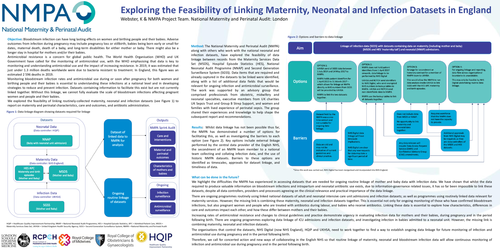
We explored the feasibility of linking routinely-collected maternity, neonatal and infection datasets (see Figure 1) to report on maternity and perinatal characteristics, care and outcomes, and antibiotic administration.
Method: The National Maternity and Perinatal Audit (NMPA) along with others who work with the national neonatal and infection datasets, have explored the feasibility of data linkage between records from the Maternity Services Data Set (MSDS), Hospital Episode Statistics (HES), National Neonatal Audit Programme (NNAP) and Second Generation Surveillance System (SGSS). Data items that are required and already captured in the datasets to be linked were identified, along with a list of additional data fields that would be relevant for ongoing infection and antimicrobial surveillance. The work was supported by an advisory group that comprised professionals from obstetric, midwifery and neonatal specialties, executive members from UK charities UK Sepsis Trust and Group B Strep Support, and women and families with lived experience of perinatal sepsis. The group shared their experiences and knowledge to help shape the subsequent report and recommendations.
Results: Whilst data linkage has not been possible thus far, the NMPA has demonstrated a number of options for facilitating this, as well as investigating the barriers to each option (see Figure 2). Key options include external linkage performed by the central data provider of the English NHS, the secondment of an NMPA team member to a national team collecting and collating infection data, and the use of historic NMPA datasets. Barriers to these options are identified as timescales, approvals for dataset linkage, and timeliness of data.
What can be done in the future?
We highlight the difficulties the NMPA has experienced in accessing datasets that are needed for ongoing routine linkage of mother and baby data with infection data. We have shown that whilst the data required to produce valuable information on bloodstream infections and intrapartum and neonatal antibiotic use exists, due to information-governance related issues, it has so far been impossible to link these datasets, despite all data controllers, providers and processors agreeing on the clinical relevance and practical importance of the data linkage.
There are ongoing programmes routinely using linked national datasets of adult and neonatal intensive care unit admissions and infection datasets; as well as programmes using routinely linked data relevant for maternity services. However, the missing link is combining these maternity, neonatal and infection datasets together. This is essential not only for ongoing monitoring of those who have confirmed bloodstream infections, but also pregnant women and people who are treated with antibiotics during labour, and babies who receive antibiotics. Linking these data is essential to explore how characteristics, differences in care and outcomes impact each other, and how these differ between mothers and their babies.
Increasing rates of antimicrobial resistance and changes to clinical guidelines and practice demonstrate urgency in evaluating infection data for mothers and their babies, during pregnancy and in the period following birth. There are ongoing programmes exploring data linkage of ICU admissions and infection datasets, and investigating infection in babies admitted to a neonatal unit. However, the missing link is combining maternity, neonatal and infection datasets.
The organisations that control the datasets, NHS Digital (now NHS England), HQIP and UKHSA, need to work together to find a way to establish ongoing data linkage for future monitoring of infection and antimicrobial use during pregnancy and in the period following birth.
Therefore, we call for concerted action and new ways of collaborating in the English NHS so that routine linkage of maternity, neonatal and bloodstream infection data will allow continuous monitoring of infection and antimicrobial use during pregnancy and in the period following birth.