1,830 posters, 67 videos, 75 audios, 29 topics, 22 sessions, 4,727 authors, 1,697 institutions
ePostersLive by SciGen Technologies S.A. All rights reserved.
RCOG World Congress 2023
June 12 - 14, 2023 | London, UK

PP.0051
Use of Augmented Reality to Facilitate Remote Learning for Complex Obstetric Procedures
Poster Presenter
Authors
Amber Moore, Dilroshini Karunaratne, Krishna Dasigan, Eleanor Sein
Affiliations
Part of Topic
Medical Education
The use of augmented reality to facilitate remote learning for complex obstetric procedures (Dr Amber Moore, Dr Dilroshini Karunaratne, Dr Krishna Dasigan, Miss Eleanor Sein)
Introduction
The GMC National training survey (2021) found that obstetrics and gynaecology ranked one of the lowest for “quality of teaching” and “clinical supervision”[1]. Hospital trusts are required to improve the educational experience for obstetric trainees and provide “training of all essential procedures specified by the curriculum”. Studies have shown areas of inadequacy in surgical skill acquisition, specifically in obstetrics, within the current training programme and within the constraints of the NHS. The COVID-19 pandemic has posed unique challenges for obstetrics and gynaecology training and many trainees feel it has had a negative impact on training. Some have seen a reduction in surgical training opportunities which many feel would require additional training time [2,3]. Few trainees feel competent in performing complex obstetric procedures, for example in the surgical management of major obstetric haemorrhage. The HoloLens 2 (HL2) is a mixed reality headset [4] which has the capability to aid medical education through incorporating virtual tools into the physical environment.[5] It can be used to live stream complex obstetric procedures for educational and training purposes via Microsoft Teams. Its incorporated microphone and speakers, allows two-way communication (between the surgical team and students). As a wearable headset, its mobile functionality enhances its use in this setting [4].
Aim
This study aimed to evaluate the use of the HoloLens2 to provide trainees with greater exposure to complex obstetric procedures without disrupting the environment within the operating theatre and allowing trainees to access remote teaching opportunities.
Methodology
A complex obstetric procedure was chosen (classical caesarean section) and consent of the patient, birthing partner and theatre staff gained. The HoloLens2 was worn by the author AM who was scrubbed during the procedure to optimise the visual field. The procedure was live streamed via Microsoft Teams to a remote and secure location in the department for obstetric doctors to observe and off-site obstetric doctors were able to join. Participants were able to communicate with the primary surgeon via the HoloLens2 device for educational purposes. Following the procedure, a questionnaire was completed. Descriptive statistics were used to analyse quantitative data and an inductive framework analysis to analyse qualitative elements.
Results
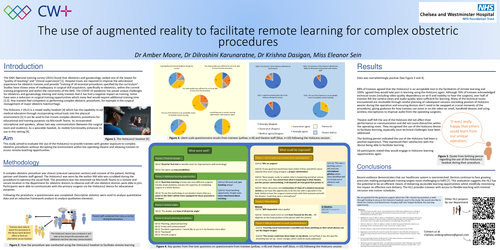
Data was overwhelmingly positive (See Figure 3 and 4). 88% of trainees agreed that the HoloLens2 is an acceptable tool in the facilitation of remote learning and 100% agreed they would take part in learning using the HoloLens again. Although 76% of trainees acknowledged technical issues (including video quality dependency on wi-fi and inability to hear the surgeon), over half of trainees felt the camera views and audio quality were sufficient for learning. Many of the technical issues encountered are resolvable through careful planning of subsequent sessions (including position of HoloLens wearer during the operation and ensuring devices don’t need to be swapped at crucial moments of the procedure), giving guidance for how trainees can zoom in on the video on small, handheld devices and using wireless microphones to improve audio from the operating surgeons.
Theatre staff felt the use of the HoloLens did not affect their performance or communication and did not cause distraction within the operating room. They recognised the use of the HoloLens device to facilitate learning, especially once technical challenges have been addressed. The birthing person indicated the use of the HoloLens had been a positive experience. They expressed their satisfaction with the device being able to facilitate learning. All participants stated they would engage in HoloLens learning opportunities again.
Conclusions
Recent evidence demonstrates that our healthcare system is overstretched. Doctors continue to face growing pressures making postgraduate training targets more challenging to fulfil [7]. This evaluation suggests the HL2 has the potential to be an efficient means of delivering accessible learning opportunities whilst mindfully minimising the impact on effective care delivery. The HL2 provides trainees with access to flexible teaching with minimal intrusion into trainer schedules.