1,830 posters, 67 videos, 75 audios, 29 topics, 22 sessions, 4,727 authors, 1,697 institutions
ePostersLive by SciGen Technologies S.A. All rights reserved.
RCOG World Congress 2023
June 12 - 14, 2023 | London, UK

PP.0049
The meaning of ‘traumatic birth event’ to obstetricians: mixed methods study
Poster Presenter
Authors
Affiliations
Part of Topic
Medical Education
The meaning of ‘traumatic birth event’ to Obstetricians: a mixed methods study
Key messages
Introduction
Childbirth can be experienced as traumatic in up to 30% women1. This can lead to several negative symptoms for both the woman and her social support. Childbirth can also negatively impact on the healthcare professionals involved, including obstetricians2, but little research has been conducted on traumatic birth events and how they may impact on the wellbeing of obstetricians. In 2021, 54% births were spontaneous vaginal births in the UK3, so just under half of all births required medical assistance from obstetricians. Obstetricians intervene in higher risk births, complicated and emergency deliveries that may result in a poor outcome for the mother and baby. It is therefore likely they will be involved in adverse or ‘traumatic birth events’ during childbirth4. The term ‘traumatic birth event’ has been used in relation to the woman and resulting posttraumatic stress disorder that can develop but no research has explored what this term means to the obstetrician.
Methodology
Objective: to explore the meaning of ‘traumatic birth event’ from the viewpoint of obstetricians and the resulting impact on their wellbeing.
Design : mixed methods exploratory study
UK obstetrics and gynaecology junior doctors were recruited via closed Facebook groups and trainee representatives, to complete an online questionnaire and attend an online semi-structured interview between August 2022-January 2023.
Descriptive statistics were conducted using Microsoft Excel and a framework analysis performed on transcribed interviews.
Results
A total of 83 questionnaires were included and 13 semi-structured interviews were conducted, which achieved data saturation.
100% of questionnaire respondents and interviewees had experience of traumatic birth events.. Stillbirth or unexpected neonatal death was cited as the most traumatic birth event by 43% of respondents.
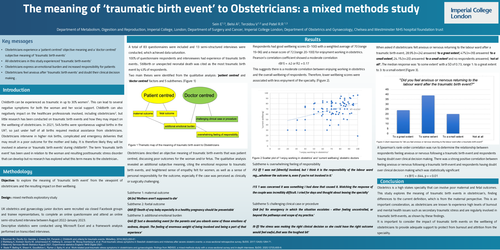
Two main theses were identified from the qualitative analysis: ’patient centred’ and ‘doctor centred’ factors and 5 subthemes.
Obstetricians described an objective meaning of traumatic birth events that was patient centred, discussing poor outcomes for the woman and/or fetus. The qualitative analysis revealed an additional subjective meaning, citing the emotional response to traumatic birth events, and heightened sense of empathy felt for women, as well as a sense of personal responsibility for the outcome, especially if the case was perceived as clinically or surgically challenging.
Subtheme 1: maternal outcome Q6 (m) ‘Mothers aren’t supposed to die’
Subtheme 2: foetal outcome Q68 (f) ‘Death of any baby especially in a healthy pregnancy should be preventable’
Subtheme 3: additional emotional burden Q46 (f) ‘Just a devastating event for the parents and you absorb some of those emotions of sadness, despair. The feeling of enormous weight of being involved and being a part of that experience’
Respondents had good wellbeing scores (0-100) with a weighted average of 70 (range 19-96) and a mean score of 72 (range 20-100) for enjoyment working in obstetrics.
Pearson’s correlation coefficient showed a moderate correlation
r(81) = .42 or R2 = 0.17
This suggests there is a moderate correlation between enjoying working in obstetrics and the overall wellbeing of respondents. Therefore, lower wellbeing scores were associated with less enjoyment of the specialty.
Subtheme 4: overwhelming feeling of responsibility I12 (f) ‘I was not [directly] involved, but I think it is the responsibility of the labour ward reg.....whatever the outcome is, even if you’re not involved in it.’
I15 ‘I was concerned it was something I had done that caused it. Watching the response of the couple was incredibly difficult. I cried for days and thought about leaving the specialty’
Subtheme 5: challenging clinical case or procedure Q48 (m) ‘An emergency in which the situation escalates - either feeling uncontrolled, or beyond the pathways and scope of my practice.’
I9 (f) ‘the stress was making the right clinical decision so she could have the right outcome would feel awful...that was the toughest bit’
When asked if obstetricians felt anxious or nervous returning to the labour ward after a traumatic birth event, 28.9% (n=24) answered ‘to a great extent’, 47% (n=39) answered ‘to a small extent’, 24.1% (n=20) answered ‘to a small extent’ and no respondents answered, ‘not at all’ . The median response was ‘to some extent’ with a SD of 0.73, range 1: to a great extent to 3: to a small extent.
A Spearman’s rank-order correlation was run to determine the relationship between respondents feeling anxious or nervous following a traumatic birth event and respondents having doubt over clinical decision making. There was a strong positive correlation between feeling anxious or nervous following a traumatic birth event and respondents having doubt over clinical decision making which was statistically significant
r s (81) = .644, p = < 0.01
Conclusion
Obstetrics is a high stakes specialty that can involve poor maternal and fetal outcomes. This study explores the meaning of traumatic birth events in obstetrician’s, finding differences to the current definition, which is from the maternal perspective. This is an important consideration, as obstetricians are known to experience high levels of burnout and mental health issues such as secondary traumatic stress and are regularly involved in traumatic birth events, as shown by these findings.
It is important to consider the impact of traumatic birth events on the wellbeing of obstetricians to provide adequate support to protect from burnout and attrition from the speciality.