1,830 posters, 67 videos, 75 audios, 29 topics, 22 sessions, 4,727 authors, 1,697 institutions
ePostersLive by SciGen Technologies S.A. All rights reserved.
RCOG World Congress 2023
June 12 - 14, 2023 | London, UK

PP.0038
A COMPARISON OF VAGINAL BROMOCRIPTINE AND ORAL CABERGOLINE IN TREATING HYPERPROLACTINAEMIC INFERTILITY
Poster Presenter
Part of Topic
Quality Improvement
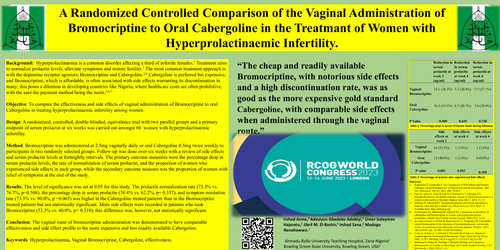
A Randomized Controlled Comparison of the Vaginal Administration of Bromocriptine to Oral Cabergoline in the Treatmant of Women with Hyperprolactinaemic Infertility.
Background: Hyperprolactinaemia is a common disorder affecting a third of infertile females.1 Treatment aims to normalize prolactin levels, alleviate symptoms and restore fertility.2 The most common treatment approach is with the dopamine receptor agonists; Bromocriptine and Cabergoline.3,4Cabergoline is preferred but expensive, and Bromocriptine, which is affordable, is often associated with side effects warranting its discontinuation in many; this poses a dilemma in developing countries like Nigeria, where healthcare costs are often prohibitive, with the user-fee payment method being the norm.5,6,7
Objective: To compare the effectiveness and side effects of vaginal administration of Bromocriptine to oral Cabergoline in treating hyperprolactinaemic infertility among women.
Design: A randomized, controlled, double-blinded, equivalence trial with two parallel groups and a primary endpoint of serum prolactin at six weeks was carried out amongst 60 women with hyperprolactinaemic infertility.
Method: Bromocriptine was administered at 2.5mg vaginally daily or oral Cabergoline 0.5mg twice weekly to participants in two randomly selected groups. Follow-up was done over six weeks with a review of side effects and serum prolactin levels at fortnightly intervals. The primary outcome measures were the percentage drop in serum prolactin levels, the rate of normalization of serum prolactin, and the proportion of women who experienced side effects in each group, while the secondary outcome measure was the proportion of women with relief of symptoms at the end of the study.
Results: The level of significance was set at 0.05 for this study. The prolactin normalization rate (73.3% vs. 76.7%, p=0.508), the percentage drop in serum prolactin (58.4% vs. 62.2%, p= 0.357), and symptom resolution rate (73.3% vs. 90.0%, p =0.065) was higher in the Cabergoline treated patients than in the Bromocriptine treated patients but not statistically significant. More side effects were recorded in patients who took Bromocriptine (53.3% vs. 40.0%, p= 0.310); this difference was, however, not statistically significant.
Conclusion: The vaginal route of bromocriptine administration was demonstrated to have comparable effectiveness and side effect profile to the more expensive and less readily available Cabergoline.
Keywords: Hyperprolactinemia, Vaginal Bromocriptine, Cabergoline, effectiveness.